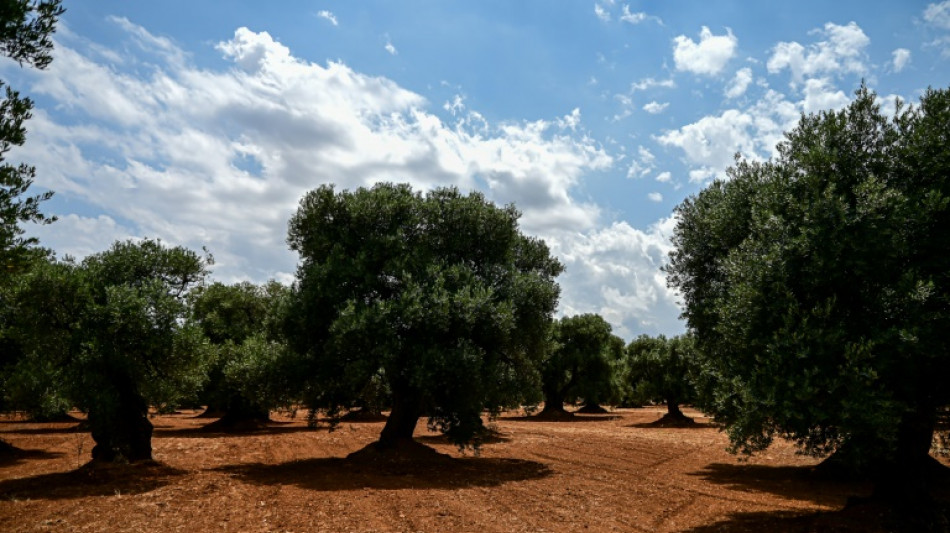
Experts, activists slam 'pointless' G7 on climate / Photo: Piero CRUCIATTI - AFP

The Group of Seven rich democracies have failed to deliver significant new progress on climate during a summit in Italy, instead reiterating previous commitments, experts and activists said Friday.
"The G7 leaders could have stayed at home. No new commitments were made," said Friederike Roeder, vice president at Global Citizen.
The leaders meeting in Puglia confirmed a pledge by their environment ministers in April "to phase out existing unabated coal power generation in our energy systems during the first half of 2030s".
But they left some wiggle room: countries can commit instead to phase out "in a timeline consistent with keeping a limit of 1.5C temperature rise within reach, in line with countries' net-zero pathways", according to the final statement.
"To stay below 1.5C, the G7's plan to phase out coal is simply too little, too late and gas is neither cheap nor a bridge fuel to a safe climate," said Greenpeace's climate politics expert Tracy Carty.
Together the G7 makes up around 38 percent of the global economy and was responsible for 21 percent of total greenhouse gas emissions in 2021, according to the Climate Analytics policy institute.
The group, responsible for nearly 30 percent of fossil fuel production, "left the door open for continued public investments in gas", said Nicola Flamigni from climate-oriented communications firm GSCC.
Britain, Canada, France, Germany, Italy, Japan and the United States also reiterated the need to agree on a new, post-2025 climate financing goal, with them as leading contributors -- but again, this was not new.
- 'No evidence' -
Dozens of climate protesters held a sit-in outside the G7 media centre in Bari, wearing T-shirts featuring an olive tree in flames emerging from a red-hot Mediterranean sea.
Europe is the fastest-warming continent and the Mediterranean is particularly vulnerable to extreme weather events caused by climate change, from droughts to floods.
Italian Prime Minister Giorgia Meloni, whose hard-right government voted against the European Green Deal, told a summit session that climate change needed to be dealt with "without ideological approaches".
But activists charged that the presence of the CEO of Italian oil and gas giant ENI at a leaders' roundtable on Africa, energy and climate showed how closely Rome's political and fossil fuel interests are entangled.
"There is no evidence that gas in Africa serves the needs of the people better and cheaper than clean energy and electrification more broadly," Luca Bergamaschi, co-founder of ECCO think tank, told AFP.
"On the contrary, gas investments in Africa have a negative impact on public budget and are a key factor in driving a worsening debt crisis," he said.
Experts also pointed to the G7's lack of commitment to remain leading contributors to the World Bank's International Development Association (IDA), which helps African countries fight against climate change.
- 'Half baked' -
The G7 announced a new Energy for Growth in Africa initiative, launched alongside several countries, from the Ivory Coast to Ethiopia and Kenya, but did not say what -- if any -- funding was attached.
It also unveiled the Apulia Food Systems Initiative -- the fourth major G7 food security initiative in 15 years -- as part of a push by the G7 to tackle the root causes of unwanted migration.
Nga Celestin, permanent secretary of the Regional Platform of Farmers' Organizations in Central Africa (PROPAC), said it was a "half-baked" initiative that would not work without engaging family farmers.
Africa's small-scale farmers produce up to 70 percent of the continent's food, according to the UN, and experts say failure to engage them has thwarted previous G7 initiatives.
The ONE Campaign slammed the G7's "pointless platitudes in Puglia", with executive director David McNair saying "this year's summit sorely missed the mark".
T.Galgano--PV