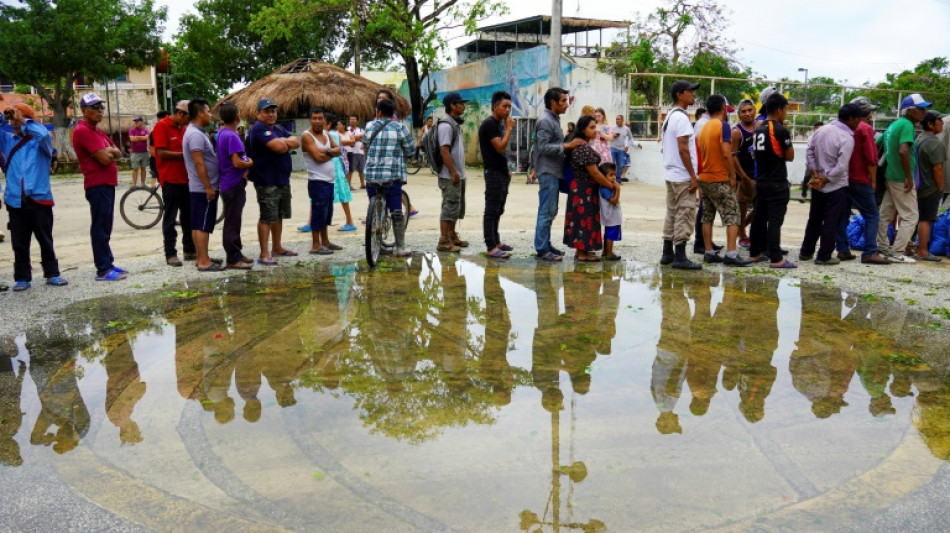
Beryl heads for Texas after causing damage, no deaths in Mexico / Photo: Elizabeth RUIZ - AFP

Beryl weakened to a tropical storm Friday after hitting Mexico as a category 2 hurricane, with fierce winds causing material damage but no immediate injuries along the touristic Yucatan Peninsula.
Now headed for the Gulf of Mexico, Beryl is expected to intensify as it moves toward northeastern Mexico and southern Texas by the end of the weekend, according to the Miami-based National Hurricane Center (NHC).
The storm hit southeast Mexico in the early morning hours with winds of up to 175 kilometers (108 miles) per hour, flattening trees and lampposts and ripping off roof tiles, according to the civil protection authority.
Electricity was lost in at least three municipalities in the southeastern Quintana Roo state, even as wind speeds slowed to about 140 km/h as Beryl moved deeper inland and weakened from a hurricane to a tropical storm.
"On the initial reports, there appears to be no loss of life, and that is what matters most to us," President Andres Manuel Lopez Obrador said in his daily press briefing.
The governor of Quintana Roo, Mara Lezama, had urged residents in a video overnight to "please stay home," and classes in the region were suspended.
About 2,200 people had sought cover at dozens of temporary shelters and more than 25,600 security force members and employees of the CFE electricity agency deployed to help affected residents and repair damage.
As a precaution, 348 flights were cancelled at Cancun airport, the largest terminal in the Mexican Caribbean.
By late Friday afternoon, Quintana Roo governor said the airport had resumed service.
- 'We have some fear' -
The NHC said Beryl had weakened from a Category 2 hurricane to Category 1 by the time she hit Yucatan -- milder than earlier in the week when it left a trail of destruction across the Caribbean and the coast of Venezuela, killing at least seven people.
It added Beryl would continue to weaken while crossing the peninsula, but "re-intensification is expected once the center moves back over the Gulf of Mexico."
Agencies and officials in northeast Mexico and the lower and middle Texas coast "should closely monitor the progress of Beryl," the center said.
"Hurricane and Tropical Storm Watches will likely be issued for that region later today."
Ahead of Beryl's arrival Friday, hundreds of tourists were evacuated from hotels along the Mexican coast.
The Mexican army, which deployed some 8,000 troops to Tulum, said it has food supplies and 34,000 liters of purified water to distribute to the population.
The army also set up a soup kitchen in Tulum for people who cannot return home due to flooding or blocked roads.
Alvaro Rueda, a 51-year-old bricklayer, told AFP his neighborhood had already started clearing up after the storm's passage.
"Most of the stores are already open... we have purchased food, even if it is canned, there is food," he said.
Virginia Rebollar, a Mexican tourist who traveled with three family members to Tulum, said their flight out had been cancelled and "we had to pay for two extra nights."
"We have some fear, but we are convinced that people are prepared and know what to do," she added.
In Cancun, a two-hour drive from Tulum, people stocked up on food and other essentials and hotels boarded up their windows.
- Climate change -
Beryl is the first hurricane since NHC records began to reach the Category 4 level in June and the earliest to hit the highest Category 5 in July.
It is extremely rare for such a powerful storm to form this early in the Atlantic hurricane season, which runs from early June to late November.
Scientists say climate change likely plays a role in the rapid intensification of storms like Beryl, since there is more energy in a warmer ocean for them to feed on.
North Atlantic waters are currently between two and five degrees Fahrenheit (1-3 degrees Celsius) warmer than normal, according to the US National Oceanic and Atmospheric Administration (NOAA).
A.Tucciarone--PV