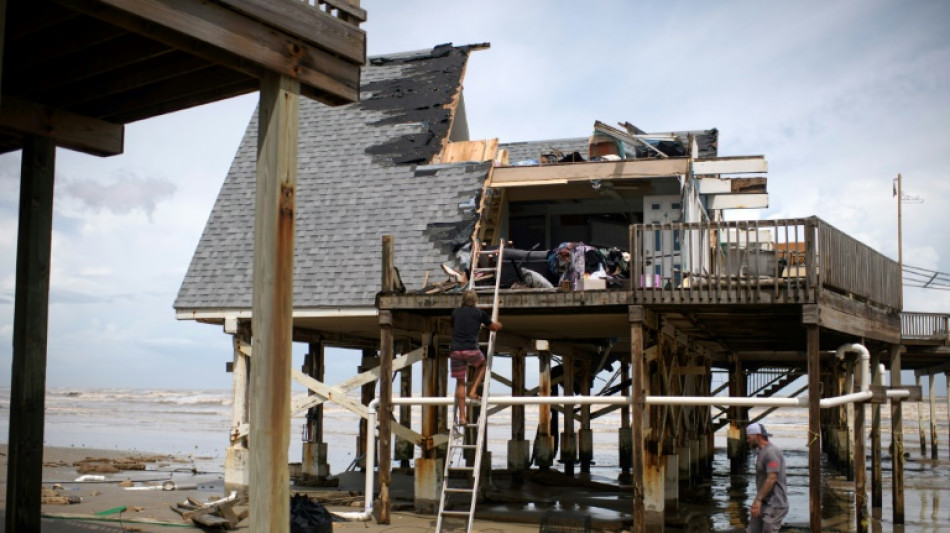
Beryl downgraded after slamming Texas with deadly rains, wind / Photo: Mark Felix - AFP

Beryl was downgraded Monday evening to a tropical depression after slamming the southern US state of Texas as a Category 1 hurricane, killing at least four people and causing millions to lose power amid scorching summer heat.
The US National Hurricane Center (NHC) said Beryl made landfall Monday morning near the Gulf Coast town of Matagorda, and was losing strength as it moved inland but still packing flood-producing rains and strong winds.
"Considerable flash and urban flooding as well as minor to isolated major river flooding is expected," the NHC said in its latest advisory, adding that "several tornadoes are possible through tonight across parts of east Texas, Louisiana, and Arkansas."
The sprawling city of Houston, home to 2.3 million people, was badly battered early Monday by hurricane-strength winds and flooding, with authorities announcing at least four deaths related to the storm.
Harris County Sheriff Ed Gonzalez said on X that a 53-year-old man and 74-year-old woman had died in separate incidents of trees falling on houses.
Later, Houston Mayor John Whitmire told a press conference that one person died after a lightning strike possibly ignited a fire, while a police department employee died in floodwaters while on his way to work.
Some 2.6 million households in Texas were without electricity as of Monday evening, according to the poweroutage.us tracker, as temperatures were forecast to climb above 90 degrees Fahrenheit (32 degrees Celsius) over the next few days.
Rose Michalec, 51, told AFP that Beryl blew down fences in her south Houston neighborhood.
"For a Category 1 storm, it's quite a bit of damage... It's more than we expected," she said.
In downtown Houston, several areas were completely inundated, including the park where 76-year-old Floyd Robinson usually walks.
"I'm seeing more of this kind of damaging water, than I've ever seen before," the life-long Houston resident told AFP.
"This is just the beginning of July and for us to have a storm of this magnitude is very rare," he added.
Along the Texas coastline, AFP journalists saw several waterfront homes and buildings with their roofs torn off in the wind.
Several communities in the area had issued voluntary or mandatory evacuation orders ahead of the storm.
- Path across Caribbean -
Meanwhile in the neighboring state of Louisiana, one death was announced by the Bossier Parish sheriff's office, also by a tree falling on a home.
The deaths on Monday raise the total toll from the storm -- which began its tear across the Caribbean as a powerful hurricane over a week ago -- to over a dozen.
Beryl first slammed Grenada, St Vincent and the Grenadines as a Category 4 storm, before plowing past the Cayman Islands and Jamaica, and at one point strengthening to a highest-level Category 5.
It hit Mexico as a Category 2 hurricane on Friday, flattening trees and lampposts and ripping off roof tiles, although there were no reported deaths or injuries there.
Beryl is the first hurricane since NHC record-keeping began to reach the Category 4 level in June, and the earliest to hit the highest Category 5 in July.
It is also the earliest hurricane to make landfall in Texas in a decade, according to expert Michael Lowry.
Scientists say climate change likely plays a role in the rapid intensification of storms such as Beryl because there is more energy in a warmer ocean for them to feed on.
North Atlantic waters are between two and five degrees Fahrenheit (one to three degrees Celsius) warmer than normal, according to the US National Oceanic and Atmospheric Administration.
H.Ercolani--PV