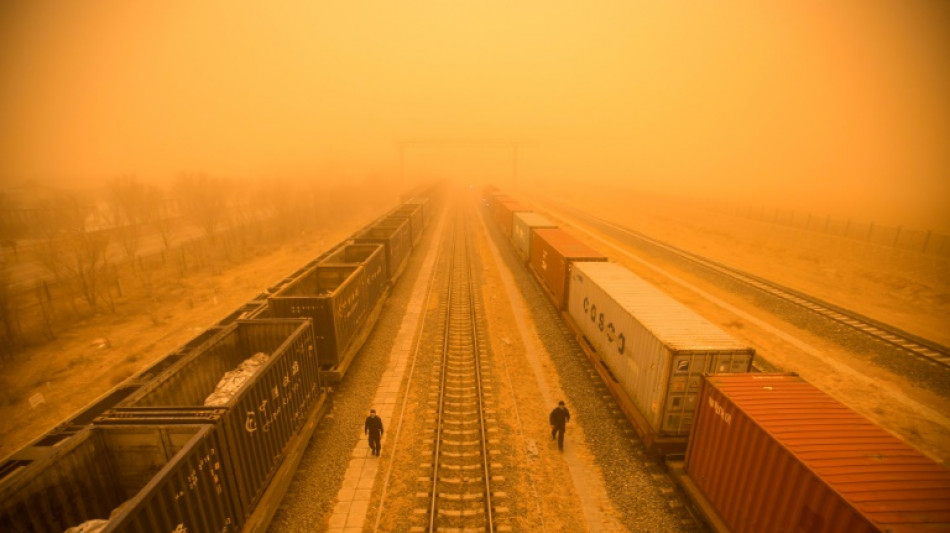
Dust in the air eased slightly in 2023: UN / Photo: STR - AFP

The amount of dust in the air eased slightly in 2023, the United Nations said Friday, warning that poor environmental management was fuelling sand and dust storms.
The UN's weather and climate agency called for greater vigilance in the face of climate change, as drier surface soil leads to more dust being carried in the wind.
"Every year, around 2,000 million tons of dust enters the atmosphere, darkening skies and harming air quality in regions that can be thousands of kilometres away, and affecting economies, ecosystems, weather and climate," the World Meteorological Organization (WMO) said in a report.
Surface dust concentrations in 2023 were slightly lower on average than in 2022, due to reduced dust emissions from regions including North Africa, the Arabian Peninsula, the Iranian Plateau, northern India, central Australia and northwestern China, the WMO said.
However, average concentrations were higher in western Central Asia, northern and central China and southern Mongolia.
The most severe dust storm of the year swept across Mongolia in March 2023, affecting more than four million square kilometres (1.5 million square miles), including several provinces in China, the WMO said in its annual Airborne Dust Bulletin.
"It caused a dramatic decline in air quality, with PM10 (particulate matter with diameters of less than 10 micrometres) concentrations in some areas exceeding 9,000 microgrammes per cubic metre.
"It reduced visibility to less than 500 metres in parts of Beijing and led to significant disruptions in transportation and daily life, highlighting the need for effective warning systems."
Surface dust concentration peaked in parts of Chad, averaging 800 to 1,100 microgrammes per cubic metre.
- Human impact -
Dust can be transported long distances by the wind. Though mainly a natural phenomenon, human activity is also driving dust storms.
"We need to be vigilant in the face of continuing environmental degradation and current and future climate change," said WMO chief Celeste Saulo.
"Scientific evidence shows that human activities are having an impact on sand and dust storms. For example higher temperatures, drought and higher evaporation lead to lower soil moisture.
"Combined with poor land management, this is conducive to more sand and dust storms."
The WMO said there were some positives to dust being transported over the oceans.
It cited a new study which concluded that Saharan dust deposits in the Atlantic impact skipjack tuna by providing iron, phosphorus and elements that favour the growth of phytoplankton.
The agency also said monitoring and forecasting accuracy had improved in recent years, notably through a system first established in 2007.
July 12 marks the International Day of Combating Sand and Dust Storms.
L.Guglielmino--PV