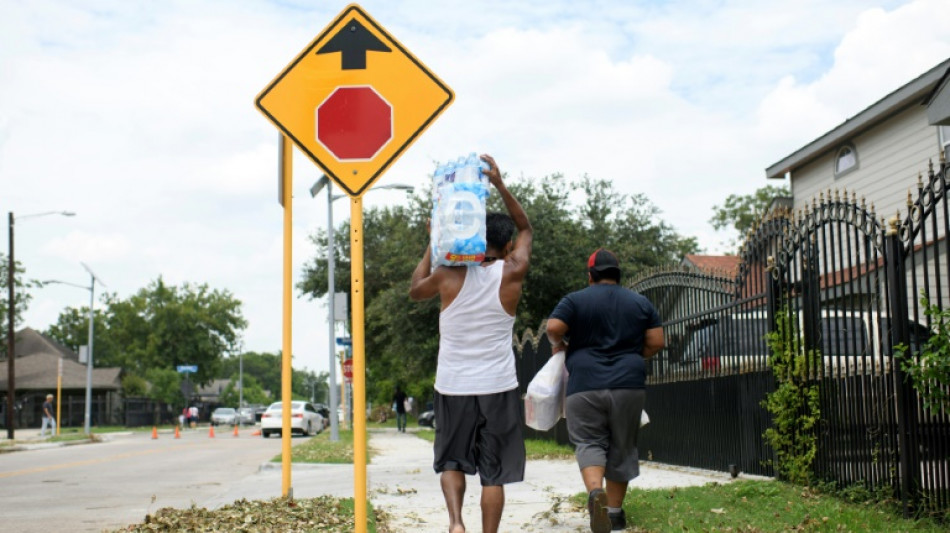
Houston residents 'in hell' after Beryl cuts power for millions / Photo: Mark Felix - AFP

Josh Vance stands in the airconditioned entrance of Sunnyside Community Center in Houston, Texas, one of the designated "cooling centers" open to the public after Hurricane Beryl knocked out power during a potent heat wave.
"Dealing with the heat at home, it's terrible. Honestly, we're suffering," he said.
Vance is among one million customers still without electricity, four days after the storm blew through the city.
Though the state's prominent oil and gas industry weathered the storm, Beryl still flooded neighborhoods and roads, uprooted trees and damaged power poles and transmission lines.
By the time the hurricane dissipated, seven people in Texas were dead and two million customers -- most of them in Houston -- were without power, with half still waiting for it to be restored by Friday, according to poweroutage.us.
While grid operators work to reconnect power, hundreds gather in cooling centers or wait in their cars to pick up ice, water and fresh food.
Vance, 43, lives in Houston with his two children and pet cat, but has spent much of the past week sheltering in the cooling center to escape temperatures which have peaked over 90 degrees Fahrenheit (33 degrees Celsius).
"You'd be amazed how much we're so acclimated to [electricity], and without the power, it's living in hell,” he said.
-'Not as prepared'-
The United States has two major power grids: one for the eastern part of the country and another for the west.
Each grid connects to different power sources, so if one state is having problems generating power, it can be redirected from other parts.
However, Texas is the only state with its own autonomous power grid, which has led to regular issues.
In February 2021, a prolonged cold storm caused the grid to collapse due to demand for heating. Natural gas lines also faced problems. Dozens of residents froze to death.
In Houston, the electrical grid is administered by the utility company CenterPoint.
Both elected officials and citizens have asked why the company has been so slow to restore power when Beryl was only a Category 1 hurricane, the lowest designation on the Saffir-Simpson Hurricane Wind Scale.
"They underestimated the impact of the storm... it would appear that they were not as prepared as they should have been," Texas Lieutenant Governor Dan Patrick said at a press conference Thursday, where he announced an investigation into the power company's response.
“I understand how frustrating it is to be without power, especially in this heat," CenterPoint CEO Jason Wells told the Houston Chronicle.
Wells highlighted the fact that the company was able to restore power to 1.1 million customers within 48 hours of the storm ending.
The progress, however, offers little consolation for those without electricity, like Maria Dionisio, who was also at the cooling center.
"There is nothing to eat, everything that was in the refrigerator is ruined," Dionisio said.
While Houston residents continue to recover, some dread an even more powerful storm this season.
"I'm praying to God there's not [a hurricane] right behind this one, because if there is, we're in trouble," Vance said.
U.Paccione--PV