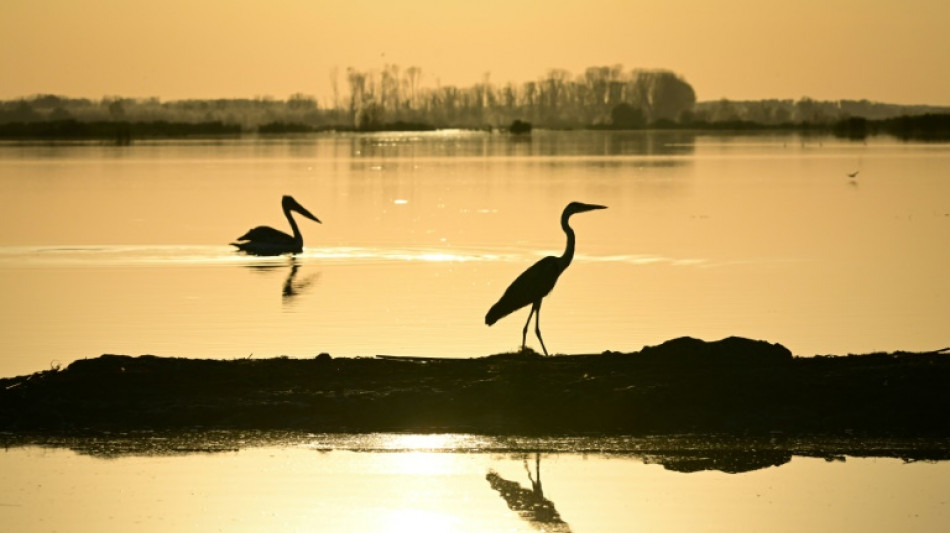
Reclaimed by floods, wildlife returns to Romania's Danube Delta / Photo: Daniel MIHAILESCU - AFP

Tour guide Eugen Grigorov steered his boat past half-underwater combine harvesters and last year's flooded crops in a part of Romania's Danube Delta reclaimed by the great river.
After a dyke burst last summer near his village of Mahmudia, swathes of the delta once drained for farmland were submerged again, creating the region's second-largest lake and a paradise for the region's battered biodiversity.
"Isn't it lovely now? Less pollution than with tractors and herbicides," the 51-year-old said, marvelling at the hundreds of wild pelicans, ducks and gulls flocking to the lake.
But while many welcome the return of wetland wildlife to the delta, local authorities are bracing for battle with farmers who want it drained again.
- 'Let the lake remain' -
Grigorov remembers how the delta first made way for crops in the 1980s, when communist dictator Nicolae Ceausescu had the reed islands burnt down and the marshes drained to turn them into farmland.
Since the floods the area has returned to what it was like 40 years ago, Mahmudia's mayor Ion Serpescu told AFP, adding the town was "happy" after the dyke breached.
Serpescu pointed to the fishermen and tourists drawn to visit his village by the lake, saying that "more than 15 guest houses have been built in two years" to accommodate them.
Estimating the cost of rebuilding the dyke at 20-30 million euros ($22-32 million), the 67-year-old believed there was little point in draining the lake again.
"Let the lake remain as it is," he said.
Many of Mahmudia's 2,000 residents hope the Romanian government will agree, after a commission of experts issued an opinion in favour of the delta's ecological restoration.
And during a visit in June, Romania's Environment Minister Mircea Fechet said that nature was "already repairing" the damage and "the delta has done nothing but reclaim its own land".
But others were less keen on the idea, with businessman Emanuel Dobronauteanu suing the local authorities for damages after losing 730 hectares (1,804 acres) of wheat, corn, sunflower and alfalfa in the floods.
Demanding "just compensation", the 58-year-old said the estimated two million lei ($435,000) in damages caused by the floods was too low a figure.
But even he said that he was not completely opposed to the lake's return, telling AFP he would be "most happy" to "go out there to fish" if he was compensated adequately.
- 'Nature takes its due' -
In 2012, Romania launched a project aimed at restoring the Danube Delta's damaged ecosystems with the help of funding from the European Union.
Environmentalists say that leaving the lake flooded would speed up the restoration process.
"Aquatic ecosystems recover much faster than forests," said biologist Dragos Balea, who coordinates the conservation group World Wide Fund for Nature (WWF)'s programmes in the delta.
"If you leave an aquatic ecosystem alone, in 10 to 15 years it will recover more than 70 percent" of its original biodiversity, Balea told AFP.
The signs are already encouraging.
"More and more birds are showing up," he said, with his project monitoring more than 90 species in the delta.
The ruptured dyke, which local authorities have blamed on a series of construction flaws, came as no surprise to the biologist.
"You can't mess with nature. Nature takes its due," he said.
F.Abruzzese--PV