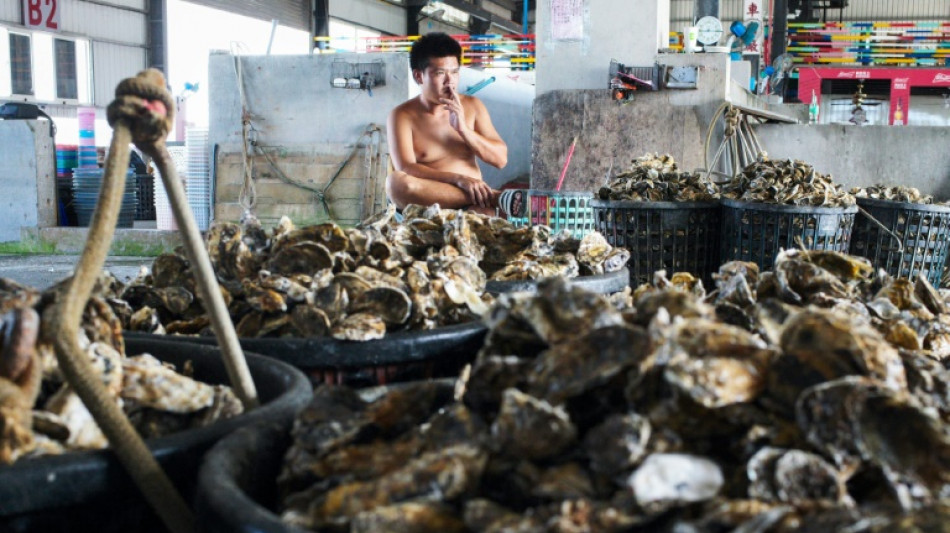
Waste into gold: Oyster shells repurposed as magic 'Seawool' / Photo: Sam Yeh - AFP

Growing up on Taiwan's west coast where mollusc farming is popular, Eddie Wang saw discarded oyster shells transformed from waste to function -- a memory that inspired him to create a unique and environmentally friendly fabric called "Seawool".
Wang remembered that residents of his seaside hometown of Yunlin used discarded oyster shells that littered the streets during the harvest as insulation for their homes.
"They burned the shells and painted the residue on the walls. The houses then became warm in the winter and cool in the summer," the 42-year-old told AFP at his factory in Tainan.
"So I was curious about why oyster shells have such a miraculous effect."
Wang's Creative Tech Textile company, established in 2010, was already producing an "eco-fabric" -- a polyester material made out of recycled plastic bottles -- but he felt its texture was a bit "ordinary".
So he started working with a research institute to experiment making fabric out of the oyster shell residue, in 2013 coming up with the right formula that produces a material similar to wool.
Today, his factory in Taiwan uses around 100 tonnes of oyster shells a year to churn out around900 tonnes of Seawool,a trademarked and patented fabric.
The fabric and clothing generate around NT$200 million (US$6.1 million) a year, with the bulk of it sourced by outdoor and sustainability clothing brands in Europe and the United States.
The Made-in-Taiwan fabric would not be possible without the island's unique oyster farming culture, Wang said.
- 'A magical yarn' -
"This industry chain cannot be found anywhere else overseas," he says.
"We have people to harvest oysters, we have specialists to clean oyster shells, and we have people for drying and calcining (treating) oyster shells."
The small island of Taiwan has a hefty appetite for oysters, harvesting an estimated 200,000 tonnes a year with the fleshy meat appearing in local cuisine such as crispy omelettes and silk-like noodle dishes.
But its popularity also means that about 160,000 tonnes of shells are discarded yearly, according to data from the agricultural ministry.
They pile up on the streets of aqua-farming towns -- the majority in western cities such as Yunlin, Changhua and Chiayi -- causing environmental issues by emitting fishy smells and providing breeding sites for mosquitos.
At Wang's factory, the shells are ground into nano beads and combined with yarn made from recycled plastic bottles.
"It creates a magical yarn," he said. "Oyster shell is a material with low thermal conductivity -- it does not absorb heat nor does it dissipate heat."
Turning the shells -- which capture and store carbon dioxide from the atmosphere -- into Seawool also does not require water, making it a "low-carbon product," said Wang.
A half-hour drive from his showroom where activewear jackets, sweaters and pants are displayed, state enterprise Taiwan Sugar Corporation (TSC) also has a factory that grinds discarded shells into a powder that is used in manufacturing household items, like incense sticks.
The crushed shells help to reduce smoke and the toxic chemicals emitted from burning incense, said Chen Wei-jen, deputy chief of TSC's biotech business division.
- From waste to gold -
"We hope oyster shells can have multiple industrial applications and interested companies can use it as a raw material to make their products more environmentally friendly and add value to their products," Chen said.
Before the shells get to the factories, farmers in Chiayi -- a county famed for producing oysters -- collect the molluscs at dawn from racks installed along the coast.
They are sorted into baskets before being sent to plants such as Dai Sen-tai's factory, where they are machine-washed before being sent to small family-run businesses that shuck the meat and send the shells south.
Dai, whose family have been in the oyster farming industry for three generations, said he is happy that Taiwan is breathing new life into the sea waste.
"When I was a child, no one wanted oyster shells -- they were dumped and discarded everywhere," he told AFP.
"It's good that the waste has been turned into gold now."
F.Amato--PV