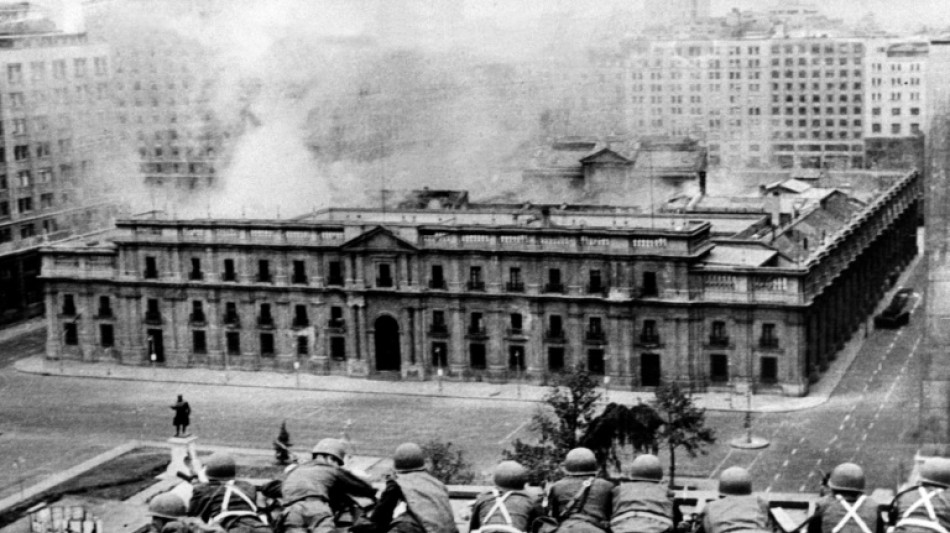
What to know about pivotal Chile coup, 50 years later / Photo: - - AFP/File

Half a century ago, Chile's La Moneda presidential palace went up in flames after being bombed by air force jets. Inside, socialist president Salvador Allende committed suicide as a coup d'etat unfolded.
"Mission accomplished. Moneda taken. President dead," was the infamous message soldiers sent to General Augusto Pinochet after a military takeover which sent shockwaves around the world, ushering in a brutal dictatorship that would last 17 years.
In Chile, which marks the 50th anniversary of the coup on Sunday, the events remain deeply divisive and continue to shape modern politics.
President Gabriel Boric will attend a ceremony to mark the anniversary, along with leaders from Mexico, Colombia, Argentina, and Uruguay.
This is what you need to know about the 1973 coup and its aftermath:
- The coup -
Chile was considered a bastion of democracy and stability in Latin America, but became increasingly polarized after the 1970 election of Marxist Allende.
His socialist policies, such as nationalization and land reform, were blamed by many for a deepening economic crisis, soaring inflation, and food shortages, which increased political tension and protests.
The United States, seeking to halt the spread of communism in the midst of the Cold War, is documented as having carried out covert efforts to destabilize the economy and support the opposition.
Army chief Pinochet carried out a coup on September 11, 1973, with troops and tanks deployed on the streets of Santiago.
His 17-year iron-fisted rule was marked by the brutal repression of opponents.
- The victims -
More than 3,200 people were killed or "disappeared" -- abducted and presumed killed -- by Pinochet's security forces, and about 38,000 were tortured.
Investigations into what happened began in 1998, and 250 agents of the dictatorship have been imprisoned, but the fate of hundreds of victims remains unknown.
"There is no closure for the fact that my brother is still missing," said Marialina Gonzalez, 59, whose childhood was marked by her mother's fruitless search for her son, a leftist activist who went missing in 1974.
Last week, Boric's government unveiled a plan -- the first-ever such government initiative in Chile -- to find out what happened to hundreds of disappeared.
- An enduring legacy -
Chile's coup reverberated around the world at the height of the Cold War, while underscoring US interference in Latin America.
To many, Allende became a leftist icon, but others blame him for political failures that led to the coup.
Pinochet is seen by some, still today, as a savior who oversaw a period of relative economic prosperity.
A survey conducted by pollster Cerc-Mori in May found that 36 percent of people believe the general "liberated Chile from Marxism," the highest figure measured in 28 years of polling.
However, when it comes to people born after the coup, 60 percent disapprove of Pinochet, according to a survey by pollster Activa Research.
Fifty years later, Chile is still trying to find its post-coup identity and shape a new political system amid ongoing debate over a new constitution.
But Allende and Pinchet cast long shadows.
The coup anniversary comes as the country is led by Boric, a 37-year-old leftist who regularly pays homage to Allende.
He came to power after a wave of social protests in 2019 which led to a referendum in which 80 percent voted to replace the Pinochet-era constitution widely blamed for Chile's deep economic inequity.
However, more than 61 percent of voters last year went on to reject a constitutional draft which would have made Chile one of the most progressive countries in Latin America.
And in May, the far-right Republican Party led by conservative lawyer Jose Antonio Kast -- a Pinochet apologist -- won 23 of 51 seats on the council that will write a new one.
In the days leading up to the anniversary, Kast's party, and other right-wing groups, refused to sign a commitment to "defend democracy from authoritarian threats" put forward by Boric.
J.Lubrano--PV