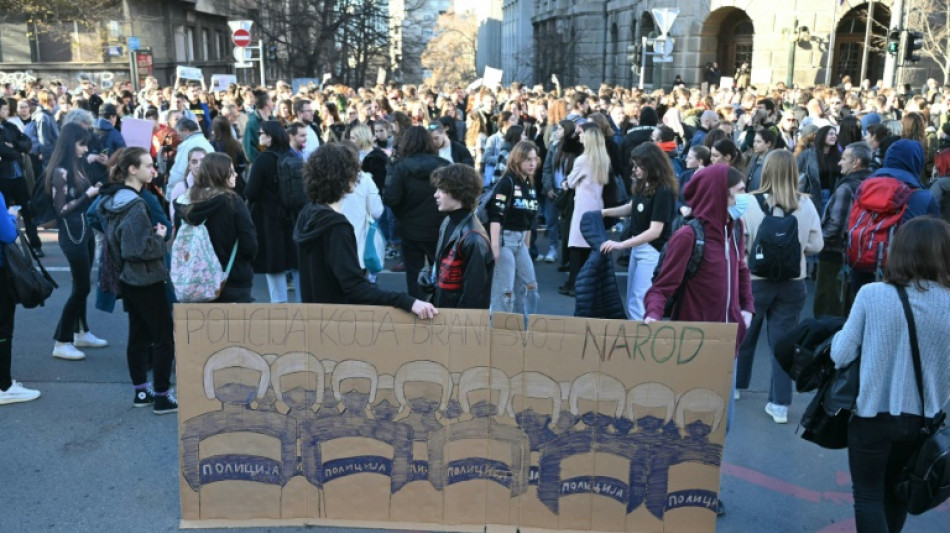
Protesters set up roadblocks over alleged electoral fraud / Photo: ANDREJ ISAKOVIC - AFP

Demonstrators set up roadblocks in the Serbian capital Belgrade Monday, to protest what they say was electoral fraud in Serbia's recent parliamentary and local elections.
President Aleksandar Vucic denounced violence in the capital the previous evening, when opposition demonstrators had tried to storm Belgrade city hall and clashed with police.
Vucic said there was evidence the violence had been planned in advance.
Moscow on Monday accused the West of interfering, suggesting that foreign actors were trying to stir up the unrest.
Early Monday, Vucic met the Russian ambassador in Belgrade Alexander Botsan-Kharchenko and briefed him on the Sunday's incidents.
Vucic is walking a difficult line balancing between East and West, vowing to keep Serbia on a course for European Union membership while also remaining friendly with Russia and courting Beijing and Washington.
On Monday, a few hundred demonstrators blocked the street in central Belgrade where the public administration and local self-government ministry is located. Other roadblocks quickly followed.
The protesters, mainly students organised under the "Borba" (Fight) movement, were supporting the opposition claims of fraud that started on December 18th, a day after the elections.
They are calling for a revision of the voter roll, claiming that it was the source of the alleged electoral fraud.
But a statement from the ministry insisted the registry was "one of the most up-to-date records".
"I am born 2002, and I thought that there would be no need, as my parents did, to fight for democracy through the street," 21-year-old politics student Emilija Milenkovic told AFP at one protest Monday.
"But I have to," she added. She was wearing the badge of "Otpor", the students' movement that in the past organised protests against former president Slobodan Milosevic.
- Russia blames West -
A day after the elections, Vucic's party said it had won more than half of parliament's 250 seats.
The main opposition coalition "Serbia against violence" denounced what it said was electoral fraud, alleging that voters from neighbouring Bosnia had been allowed to cast ballots illegally in the capital.
International observers -- including representatives from the Organization for Security and Co-operation in Europe (OSCE) -- reported "irregularities", including "vote buying" and "ballot box stuffing".
Several Western countries also expressed concern.
Germany, for one, labelled the reported allegations "unacceptable" for a country hoping to join the European Union, while a statement from Brussels said Serbia's "electoral process requires tangible improvement and further reform".
On Saturday, Serbian prosecutors asked the police to probe allegations of fraud.
Vucic was not himself on the ballot for these elections, and the only support for him after his Serbian Progressive Party (SNS) declared victory came from Moscow.
"The attempts of the collective West to destabilise the situation in the country are obvious," Russian foreign ministry spokeswoman Maria Zakharova told state-run news agency RIA Novosti.
She compared the unrest to the 2014 Maidan protests in Ukraine, when protesters forced a Russian-backed leader from power in what Moscow insists was a Western-backed action.
- Protests spread -
On Monday, after the street in front of the public administration ministry had been blocked, protests spread to other streets.
The main one appeared to be in front of the offices of the state electoral commission in central Belgrade, already the site of several such protests in recent days.
Seven members of the main opposition camp, united under the banner "Serbia Against Violence" meanwhile, are on a hunger strike aimed at getting the results annulled and elections re-run.
A deputy from the opposition "Serbia against Violence" coalition, Radomir Lazovic told AFP it was still possible for the crisis to end "if they admit the fraud and cancel the elections".
Lazovic said he had been beaten by police during Sunday night's clashes.
D.Vanacore--PV