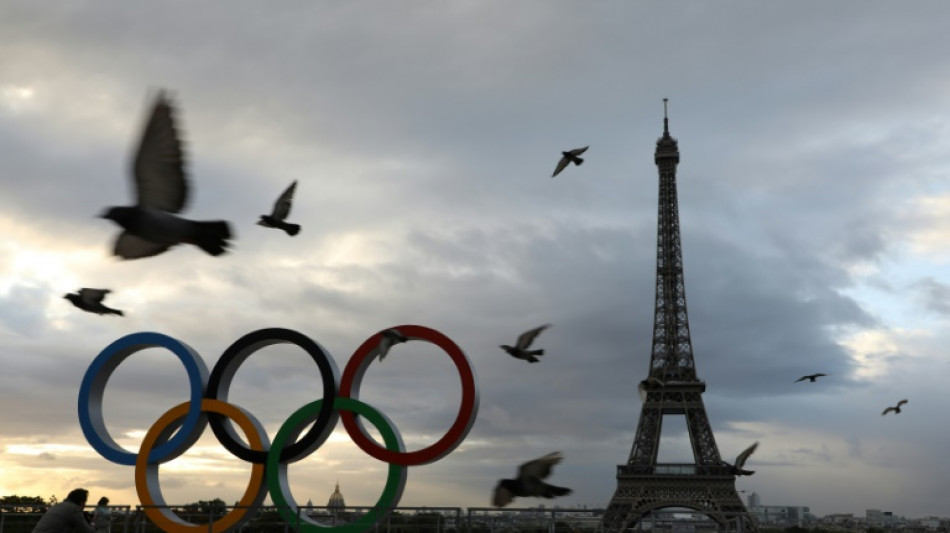
Russia, Belarus Olympic volunteers shown the door over 'security' fears / Photo: LUDOVIC MARIN - AFP/File

When Diana, a Russian national living in France, received notification late last year that she had been selected as a volunteer for the Paris Olympics, she was ecstatic.
"It was the best Christmas gift ever," said the 31-year-old woman, who requested her last name be withheld.
Diana, who also served as a volunteer during the 2014 Sochi Winter Olympics, was eager to share her experience and contribute to the "grandiose event."
She received a mission assignment, attended a volunteer convention in March, underwent some training and was looking forward to getting her uniform in May.
Then came a letter from Olympic organisers indicating she had failed background checks. Citing the French internal security code, the organisers said they were not aware of the specific reason and were only informed of the decision by officials conducting the checks.
"The mission you accepted is unfortunately no longer assigned to you, and you will receive no further communication from us," said the letter.
Diana, who works for a major French company, was shaken. "I realised I present a major danger to this country. Only I don't understand why."
- 'Treating us like terrorists' -
Diana is not alone. Many Olympic volunteers with Russian and Belarusian passports -- some living in France, others living in their home countries -- have reported receiving identical letters, citing security risks.
Russian-language online groups are full of anger as volunteers wonder what to do next. Diana is considering whether to file a legal complaint against the French interior ministry that she holds responsible for the ban. She said she had been contacted by around 20 people in the same situation.
The Paris Olympics will be held under the shadow of Russia's war against Ukraine. Russian and Belarus athletes can compete only as neutrals. The French security services worry Moscow could be seeking to disrupt the Games.
A total of 45,000 people were selected to serve as volunteers at the July 26-August 11 Olympics and the Paralympics, on August 28-September 8.
In March, French Interior Minister Gerald Darmanin said that "we absolutely check everyone," adding around 800 people who "did not have good intentions" had already been excluded.
The interior ministry declined to comment.
It is unclear how many Russian and Belarusian citizens are affected. But several volunteers told AFP they believed their cases were not isolated and applications from Russians and Belarusians were rejected at the last minute due to their nationality.
Kremlin spokesman Dmitry Peskov said the organisers were depriving Russian-speaking guests of help from the volunteers "who could best assist them."
"We can only express regret," he said.
Dzmitry Shaliapin, a 19-year-old from Belarus who is studying at the Sorbonne in Paris, has dreamt of becoming an Olympic volunteer for years.
When he received a letter from the organisers this week, he did not immediately realise what it meant. "Do you understand that we are being kicked out from the Olympics?" a fellow volunteer told him. Shaliapin said he cried when the news sank in.
"They are treating us like terrorists," he said.
- 'Gift to Putin' -
A 45-year-old Russian woman, who requested anonymity, said her candidacy had also been turned down even though she received asylum in France following Moscow's invasion of Ukraine and handed in her Russian passport.
"All of my ties to Russia have been cut," said the language instructor. She was hoping to volunteer at the Paris Games as a way to give back to her host country. "Sport is the antithesis of war and aggression," she said.
She is concerned France's decision will only reinforce Russian leader Vladimir Putin's narrative that the West is at war with Russia.
"This situation is a gift to Putin and his propaganda," she said. "This is outrageous."
Ekaterina Pimenova, a 18-year-old resident of Saint Petersburg, was registered to serve as a volunteer at the Paralympics and spent around 2,000 euros ($2,140) on plane tickets and accommodation in France.
Then the rejection letter came.
"I don't know why this has happened. I don't have a criminal record," said Pimenova, who has studied French for the past 12 years.
Mark Galeotti, an expert on Russian security services, suggested France wanted to play it safe.
"However, there is always a dilemma here, whether to err on the side of caution and end up excluding even some who are entirely innocent, or to be generous and risk letting in Russian assets."
Jules Boykoff, who teaches political science at Pacific University in Oregon, said: "The sudden decision to jettison already-approved Olympic volunteers from Russia and Belarus is not only uncommon, but it also makes one wonder about the initial vetting process.
"Did new information about the volunteers come to light? Or is discrimination rearing its ugly head?"
Since the start of Moscow's invasion of Ukraine many Russians residing in the West have been affected by the fallout of Western sanctions. Some cannot open bank accounts, others had their accounts suspended.
Many worry the volunteering ban sets a new precedent.
"What will happen next?" said Shaliapin.
I.Saccomanno--PV