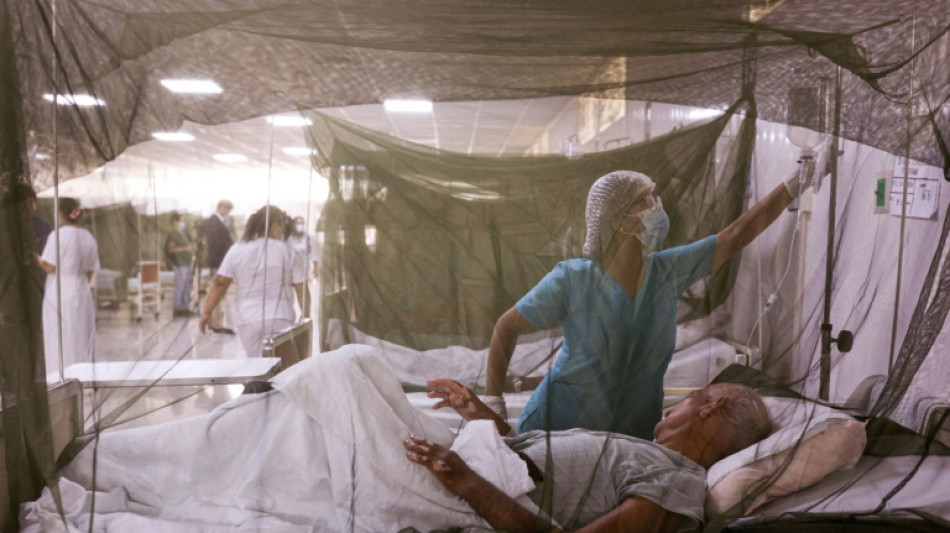
Pandemic agreement talks go to the wire / Photo: Juan Carlos CISNEROS - AFP

Hectic last-ditch talks aimed at striking a landmark global agreement on handling future pandemics rolled into the final day on Friday with a deal still up in the air.
Two years of work on drafting an international accord on pandemic prevention, preparedness and response are coming to the crunch, with just hours left to find a consensus.
In December 2021, the raw pain of Covid-19 -- which killed millions, shredded economies and crippled health systems -- motivated countries to seek a binding framework of commitments aimed at preventing another such disaster.
However, big differences quickly emerged on how to go about it -- fractures which still had not been healed going into Friday.
World Health Organization chief Tedros Adhanom Ghebreyesus voiced optimism that the talks would prove successful and conclude an agreement ready to be formally adopted at the annual gathering of WHO member countries, which runs from May 27 to June 1.
"I am encouraged that all 194 member states are strongly committed to finalising the agreement in time for the World Health Assembly," he said on Wednesday.
"They are working long hours to find common ground, in good faith, for the people of the world."
- Rush to the finish line -
Fuelled by trolleys full of coffee, bananas, biscuits and sandwiches, negotiators have been pulling 12-hour days since April 29 to try and find a way through.
The additional fortnight of talks -- the process was meant to finish in March -- are being held behind closed doors at the WHO headquarters in Geneva.
Those non-governmental organisations deemed relevant stakeholders can follow the process outside the room and are briefed daily by the talks' co-chairs.
Such NGOs fear that any agreement concluded on Friday would be rushed, may not change the status quo, and may even entrench some of the weaknesses exposed by the Covid-19 pandemic.
While finding consensus on every article in the draft agreement would be unlikely, countries have nonetheless invested a lot of time in the process and want something to show for their efforts.
"We are telling them: don't be under pressure to surrender on equity because you need to deliver an instrument," said K. M. Gopakumar, senior researcher with the Third World Network NGO.
"We are afraid that will lead to a situation where they will be asked to compromise just to create a photo-op" to show that the treaty has been adopted.
"That would be a betrayal of people's aspirations and people's right to health."
- Vaccine sharing -
The draft text proposed giving the WHO real-time access to 20 percent of the production of pandemic-related health products, such as vaccines.
While some countries want this changed to at least 20 percent, some Western powers are pushing for it to be up to 20 percent.
Each of the draft agreement's 37 articles is being thrashed out in turn, with country negotiators breaking off into working groups to try to figure out a consensus.
Pedro Villardi, health equity coordinator for Public Services International, said front-line healthcare staff needed to be properly protected in the agreement, which should reflect their burden of exposure to risk.
Otherwise, "the workers that we represent as PSI, their lives are still going to be on the line" in the next pandemic, he said.
Villardi said the effort required to get a reference in the agreement to the mental health toll on front-line workers was "just unbelievable, it's outrageous".
- Fault lines -
The main disputes revolve around access and equity: access to pathogens detected within countries and to pandemic-fighting products such as vaccines produced from that knowledge; and equitable distribution of not only counter-pandemic tests, treatments and jabs, but also the means to produce them.
Speaking from South Africa, Lauren Paremoer of the People's Health Movement, a senior lecturer at the University of Cape Town, told reporters that Africa had been "heavily marginalised" during the last pandemic, in terms of access to vaccines and other medical products.
"The treaty as it stands will not correct any of that," she said, noting that much of the language on technology transfer to developing countries was non-binding.
"The treaty places new and very onerous (pathogen) surveillance obligations on African countries with absolutely no clear promise that funding will be made available," she said.
R.Lagomarsino--PV