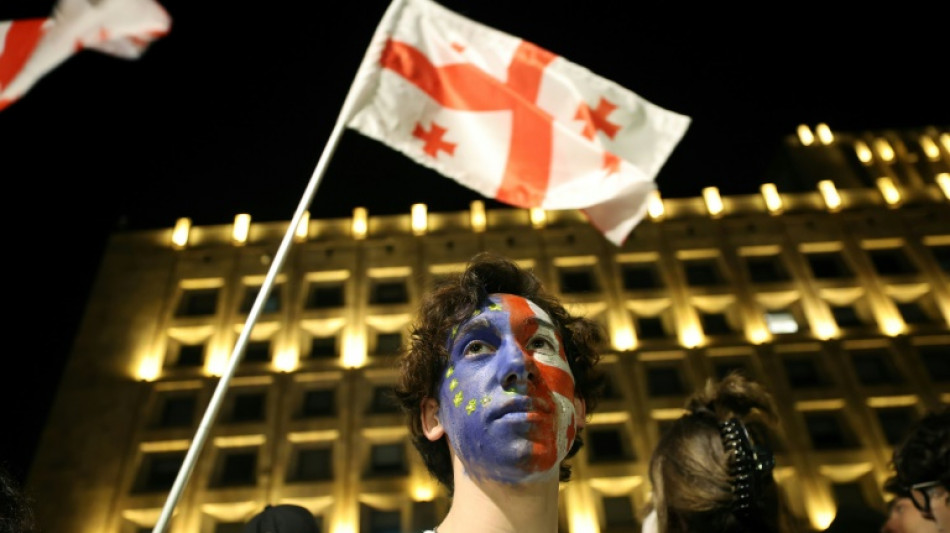
'As long as it takes': Georgia's Gen Z leading street protests / Photo: Giorgi ARJEVANIDZE - AFP/File

In a hip coffee shop in Georgia's capital Tbilisi, 21-year-old Tekla Jailava is serving her last few cappuccinos before heading for a third night of protests against an anti-NGO law she fears will ruin the Black Sea country's ties with the West.
Growing up in the 2010s, the barista always dreamt Georgia would one day join the European Union.
"Since my childhood, we have always leaned towards Europe, culturally and in every other way," she told AFP.
But now she fears the adoption of a controversial "foreign influence" law is steering her country back to the past -- and closer to Moscow.
Critics say the law, which was passed this week and requires advocacy groups and media outlets to register as agents of "foreign influence" if 20 percent of their funding comes from abroad, resembles Kremlin legislation used to quash dissent.
Jailava accused the ruling Georgian Dream party of "silencing people and turning them towards the Soviet Union" as they forced the measures through parliament in the face of a massive public backlash.
The EU says the law goes against Georgia's stated aspirations to join the bloc.
Worried their promised EU future is being stolen, tens of thousands of young Georgians have filled the streets of Tbilisi in nightly protests.
- 'Same old methods' -
Similar plans had been quashed last year amid public outcry, but were revived in April -- just four months after Brussels granted Georgia official EU candidacy status.
The authorities have also launched an aggressive media campaign against NGOs, and government critics have been attacked in the street and seen their homes covered in posters reading "foreign agent".
"They are trying to scare people with the same old methods," Jailava said, referring to Soviet-era repression.
But those tactics "will not work" on Georgia's Gen Z, she said.
"The young people of Georgia have made up their minds, we've been very vocal about where we want to go: to the EU," said activist Ana Tavadze.
She accused Bidzina Ivanishvili, the billionaire behind Georgian Dream who made his fortune in Russia, of "jeopardising Georgia's European future".
- 'Taking away my future' -
At 26, Tavadze is one of the older protesters. Many are still in their teens, baby-faced and fresh out of school.
"This law is taking away my future," said 19-year-old Anano Plievi, standing outside parliament as it passed its third and final reading on Tuesday.
The comparisons to Kremlin legislation have intensified the backlash.
"My education, the way my brain has re-classified things, counters anything Russian," said Jailava.
She was a child when Russian tanks rolled into Georgia in the 2008 war and despises the way Moscow has treated Tbilisi for more than a century.
Chanting "No to the Russian Law!" Georgia's Gen Z, many wrapped in EU flags, have taken over Tbilisi's main Rustaveli Avenue.
Spontaneous and chaotic, the rallies often start late and go on until dawn.
"There is no plan, we just want to keep going and continue the pressure," said 23-year-old Ana Maisuradze.
They say being a leaderless movement is a boost, though some worry it will die out without a plan.
Riot police have violently dispersed several of the rallies, detaining and beating some protestors.
And Prime Minister Irakli Kobakhidze, 45, last week hit out at young people in a long post on Facebook -- a social media platform many no longer use.
Depicting them as violent mobs, he accused the opposition of "financing the Gen Z movement".
- Leaderless -
Georgian Dream has also tried to associate the protestors with the United National Movement -- jailed ex-President Mikheil Saakashvili's opposition party that lost power 12 years ago.
The young demonstrators say the charge of political affiliation is ridiculous, with many barely remembering life under the previous government.
"We are not in coordination with political opposition parties," said leader Luka Beraia, 24, head of a student organisation taking part in the protests.
Instead, they accuse parts of the opposition -- also unpopular -- of trying to ride the wave of their popularity.
On Tuesday night, thousands of students booed opposition leaders who took to a stage outside parliament.
Beraia said he hoped some of the street protesters would themselves enter politics, combining forces to defeat Georgian Dream in October elections.
The vote is seen as a crucial test of Georgia's democratic transition, three decades after the fall of the Soviet Union.
Although the "foreign influence" law has been adopted, the turmoil looks far from over.
Salome Zurabishvili, the country's pro-EU president, has said she will veto the law. Her veto is then likely to be overturned by Georgian Dream.
Heading out for that evening's demonstration, Jailava vowed: "I'll be there for as long as it takes."
R.Lagomarsino--PV