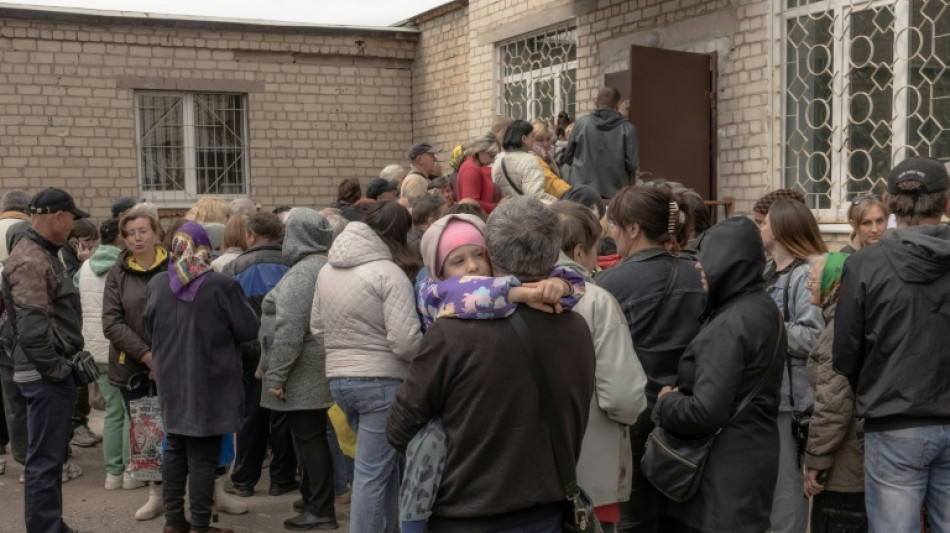
'Get out now': Kharkiv region evacuees wait for stranded relatives / Photo: Roman PILIPEY - AFP

Nina Kozyr looked around the courtyard of the evacuation centre in the Ukrainian city of Kharkiv, hoping for news of her parents.
Aged 87 and 92, they had initially refused to flee their bombed-out village in Ukraine's northeast, where Russian forces launched a major ground assault last week.
"I'm all swelled up from crying every five minutes... My parents said: 'Go away, we are sick of you here,'" said Kozyr, who had begged them to leave with her.
Faced with thousands of invading Russian soldiers, fleeing may seem like the obvious decision.
But some locals, unwilling or unable to fathom a life beyond their village, are refusing to abandon their homes.
For their relatives standing by in Kharkiv, this means a long and fraught wait.
Phone service is patchy in war-torn areas, meaning hours without contact.
Adding to the anxiety, Ukraine has accused Russian forces of taking dozens of civilians prisoner in the area.
"Old people don't want to leave at all... that's it," Kozyr sighed.
Most of the people who stayed behind are over 70, said Katherina Lavrenko, a humanitarian manager at the Relief Coordination Center.
"Grandmas and grandpas... they think it will all end soon, that they will be able to stay at home (where) they have cats, goats, pigs, ducks," said Lavrenko.
Ukraine has evacuated almost 9,000 people in the week since Russian forces stormed across the border on May 10.
Russia says it has captured 12 villages in the Kharkiv region so far, with its troops still advancing.
- 'Should have listened' -
The Ukrainian volunteers and police evacuating people are legally forbidden from even trying to persuade people to come with them, Lavrenko said.
They need to wait for a request to evacuate -- even if it does not arrive until the very last minute.
Houses in Vovchansk were already burning when Oleksandr Stryzhakov heeded the calls of his wife and daughter to leave the city.
"I should have listened to my daughter! She was begging me to leave," the 68-year-old Stryzhakov told AFP.
Having survived a "terrifying" escape from the partially destroyed city with his son, Stryzhakov was sitting with his wife Valentyna on single beds in their dorm room.
All they had left with them were a few plastic bags, and some food packages from aid groups.
Valentyna arrived a few days earlier and had been walking up and down the corridors of the dorm, helplessly waiting for news.
She kept trying to call her husband and her son, shouting: "Get out now!" whenever it seemed they had a connection.
She had little doubt what finally pushed her husband out.
"Did you buy cigarettes?" she asked him, rolling her eyes as both smiled.
"I did! It's the most (important). If there's no cigarettes, it's death!" said Stryzhakov, laughing.
The reunited family could breathe a sigh of relief, but others were growing increasingly nervous amid reports of more Russian advances.
- 'Mum just called' -
Ukrainian authorities said Russian forces have begun destroying Vovchansk.
They have also accused them of capturing dozens of civilians to use as "human shields" to defend their command headquarters.
AFP was not able to immediately verify the claim.
Relatives of people who stayed behind were struggling to find out what was going on.
Kira Dzhafarova managed to get through to her mother, 85-year-old Valentina Radionova, in Vovchansk.
"Mum just called. We heard: I am fine," she told AFP via text message.
Dzhafarova couldn't make out anything else on the call. Then a neighbour of her mother said a bomb had landed near the house.
The blast had blocked the entrance, but Radionova could probably still have climbed through a window into her garden to leave.
But she did not want to hear anything about leaving her land, Dzhafarova told AFP.
Radionova had long looked for the perfect home next to the river.
"As soon as the water got warm, until the fall, she would swim. That's why she chose this particular house," she said.
In a garden, she "grew peppers, tomatoes, cucumbers, zucchinis, eggplants, cherries, strawberries, raspberries -- everything."
She would prepare jars of jam to send to her grandchildren living in both Ukraine and Russia.
Dzhafarova, a trained psychiatrist, believed fear may have paralysed her mother and stopped her leaving the village.
She hoped she would yet change her mind, even if that meant going to live in Russia with her son.
Dzhafarova, who has stopped talking to her brother during the war, said she hoped her mother could "at least live" somewhere calmer.
"If she says 'yes, I'm ready to leave,' then we will do everything we can to get her out," she said.
H.Lagomarsino--PV