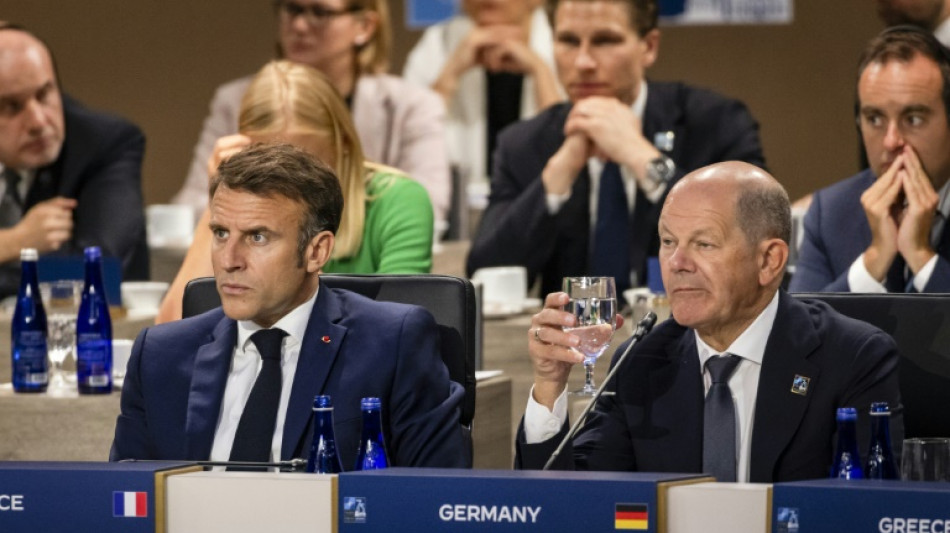
Bumper election year brings headwinds for liberal democracies / Photo: SAMUEL CORUM - AFP/File

Voting by more than half the world's population in 2024 elections has left many liberal democracies facing crises of confidence, political fragmentation and heightened polarisation, with some observers fearing new wind in the sails of authoritarianism.
The bumper election year was headlined by the November polls in the United States, democracy's self-described "shining city upon a hill", where Donald Trump emerged victorious.
Many post-vote analyses have focused on the economic drivers for the public's rejection of the Democratic party incumbents.
Trump's repeated threats to undermine the rule of law also appear to have done little to discourage voters.
The Republican has vowed to bring to heel a justice system that had targeted him with multiple investigations and trials, to punish hostile media outlets and even name civil servants on the basis of their ideological allegiances.
If Trump does everything he has said he will, "the United States will see the most intense assault on checks and balances and civil liberties in its peacetime history", political scientist Larry Diamond wrote in Foreign Affairs.
- Polarised and fragmented -
"We are at a dangerous moment, not only in the US but in many other places," Max Bergmann of the Center for Strategic and International Studies (CSIS) told AFP.
For the past two decades, the Western democratic model installed since 1945 and reinforced following the collapse of the Soviet bloc after 1989 has been on the back foot.
The US-based organisation Freedom House has highlighted increased violence and suspected or confirmed manipulation around many elections worldwide.
Elsewhere, some so-called "hybrid" systems saw powerful incumbents retaining their position but faced with determined, organised and new opposition.
India's Narendra Modi and Turkey's Recep Tayyip Erdogan suffered setbacks at legislative and municipal elections respectively.
Even in more competitive democratic systems, such as in Europe, "we are seeing increasingly polarised and fragmented politics", Bergmann said.
Germany's governing alliance between Social Democrats, Greens and Liberals collapsed this month, with little clarity about how a new government will look following new polls in February.
And in the neighbouring Netherlands, a fragile four-way coalition is battling internal division as it tries to stay afloat following the previous government's 2023 implosion.
France, where monolithic parties of left and right for decades took turns at power, has also seen its political landscape shattered since centrist Emmanuel Macron surged to the presidency in 2017.
His snap election surprise in summer has produced a parliament almost evenly divided between three blocs -- a united left, centre-right and far right.
With all sides at daggers drawn on almost every subject, reform efforts have been paralysed.
- 'Halt change' -
The volatile state of Western democracies can be explained by a "crisis of confidence in political parties and in the media that is unprecedented since 1945", said Bertrand Badie, an international relations expert at French university Sciences Po.
Voters were reacting to "a drought in what's on offer in politics", he added.
"What were Macron or Kamala Harris offering in France or in the US beyond preventing their rivals -- Trump or the far right led by Marine Le Pen -- from taking power? This creates a big problem with legitimacy."
Defiance towards traditional parties and incumbents has added to the attraction of populist and far-right parties.
Those made big gains in June's European elections as seen in votes in Germany, France, the Netherlands, as well as in Italy and Hungary prior to 2024.
Many voters are opting for politicians promising the toughest action on issues including immigration and purchasing power.
Personality is vital too, with Hungary's Viktor Orban and Trump managing to project implacable authority.
"The world and societies are going through a major transformation. Liberal globalisation has not brought answers for millions of people concerned about sometimes radical changes in the way we live alongside others, travel or produce," said Gilles Gressani, head of French geopolitical magazine Le Grand Continent.
"In consequences, there's increasingly strong demand to halt change -- and because that seems increasingly unlikely, the illusive temptation to withdraw" behind national borders, he added.
B.Cretella--PV