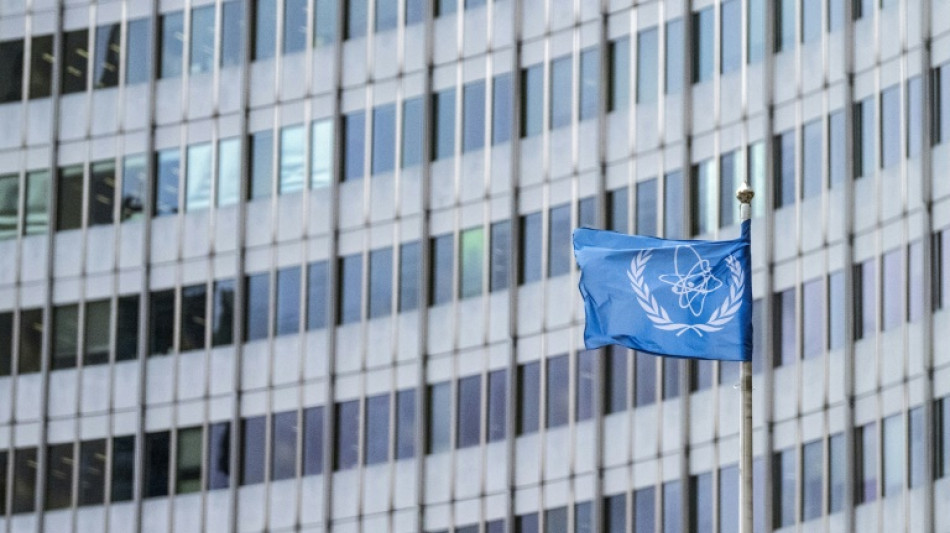
Iran to hold nuclear talks with three European powers / Photo: Joe Klamar - AFP/File

Iran is set to meet with Britain, France and Germany for talks Friday on its nuclear programme after the three governments joined with the United States to have Tehran censured by the UN atomic watchdog.
Last week's chiding prompted a defiant response from Tehran, but its officials have since signalled willingness to engage with others ahead of the return of US president-elect Donald Trump, whose last administration pursued a policy of "maximum pressure" against the Islamic republic.
Iranian diplomat Majid Takht-Ravanchi, who serves as the political deputy to Foreign Minister Abbas Araghchi, is scheduled to represent Iran in Friday's talks.
He will meet beforehand with Enrique Mora, deputy secretary general of the European Union's foreign affairs arm, according to the IRNA state news agency.
Last week, the 35-nation board of governors of the UN's International Atomic Energy Agency (IAEA) adopted a resolution condemning Iran for its lack of cooperation on nuclear issues.
Iran described as "politically motivated" the resolution brought by Britain, France, Germany and the United States.
In response, Tehran announced the launch of "new advanced centrifuges" designed to increase its stockpile of enriched uranium.
Tehran's willingness to sit down with the three European countries so soon after the censure comes just weeks before Trump is set to return to the White House.
During his first term, Trump focused on re-imposing heavy sanctions on Iran following the United States' unilateral withdrawal from a landmark 2015 nuclear deal three years after it was established.
That agreement between Tehran and major powers aimed to give Iran relief from crippling Western sanctions in exchange for limiting its nuclear programme to prevent it from developing a nuclear weapon.
Tehran has consistently denied any intentions of pursuing atomic weapons.
In retaliation for the US withdrawal, Tehran has reduced its compliance with the deal, raising its uranium enrichment levels to 60 percent -- close to the 90 percent required for a nuclear bomb.
For Tehran, the goal of the talks on Friday is to avoid a "double disaster" scenario, in which it would face renewed pressures from both Trump and European nations, according to political analyst Mostafa Shirmohammadi.
He noted that Iran's support among European nations had been eroded by allegations it offered military assistance for Russia's invasion of Ukraine.
Iran has denied these accusations and hopes to mend relations with Europe, while also maintaining a firm stance.
- 'Legal obligations' -
The IAEA's censure resolution urged Iran to "fulfil its legal obligations" under the Non-Proliferation Treaty (NPT) ratified in 1970, which requires member states to declare and maintain their nuclear materials under IAEA supervision.
In response, Foreign Minister Araghchi, who was instrumental in the nuclear negotiations in 2015, said Iran was commissioning "several thousand advanced centrifuges".
The head of the Atomic Energy Organisation of Iran, Mohammad Eslami, said Wednesday that they had begun inserting gas into the centrifuges.
Centrifuges work by rapidly spinning uranium gas to increase the proportion of the fissile isotope U-235.
Iran insists on its right to nuclear energy for peaceful purposes, but according to the IAEA, it is the only non-nuclear-weapon state enriching uranium to 60 percent.
Under the 2015 accord -- which will expire in October 2025 -- Iran's enrichment was capped at 3.67 percent.
In an interview published on the eve of the talks, Araghchi warned frustration in Tehran over unmet commitments, such as lifting sanctions, was fuelling debate on whether the country should alter its nuclear policy.
"We have no intention to go further than 60 percent for the time being, and this is our determination right now," he told Britain's The Guardian newspaper.
But, he added, "there is this debate going on in Iran, and mostly among the elites... whether we should change our nuclear doctrine" as so far it has proven to be "insufficient in practice".
Supreme leader Ayatollah Ali Khamenei, who has the final authority in Iran's decision-making, has issued a religious decree, or fatwa, prohibiting the use of atomic weapons.
Iran's nuclear programme dates back to the late 1950s when the United States, then an ally, signed a civil cooperation agreement with Shah Mohammad Reza Pahlavi.
A.Saggese--PV