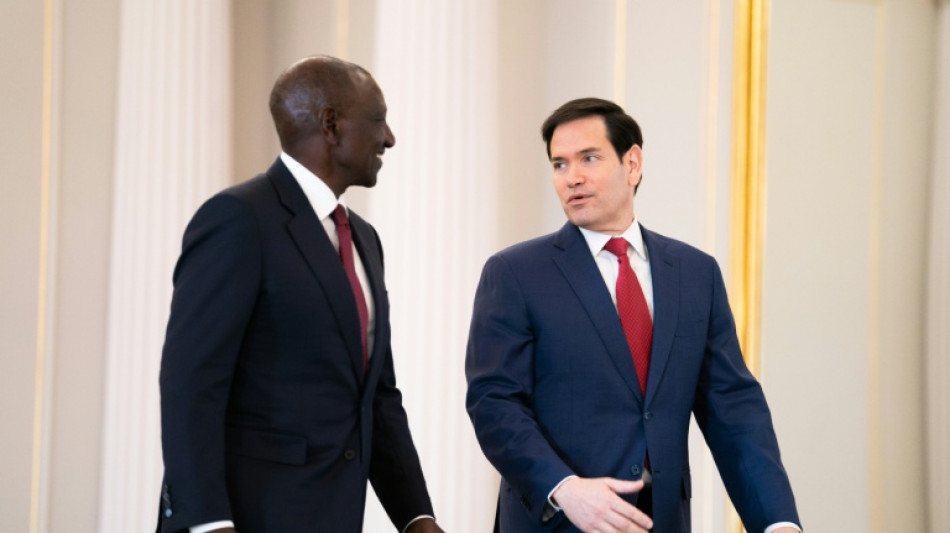
US signs health aid deal with Kenya in Trump first / Photo: Allison ROBBERT - AFP

The United States on Thursday signed a $2.5 billion health aid deal with Kenya, the first such bilateral agreement after President Donald Trump tore down the historic US aid agency and sidelined NGOs.
Trump administration officials said the agreement would be the first in a series of agreements with developing countries' governments, which will be asked to share the bill and cooperate with Washington on other priorities.
Secretary of State Marco Rubio signed the agreement in Washington with Kenyan President William Ruto, whom he praised for the longtime US partner's assistance in troubled Haiti.
"If we had five or 10 countries willing to step forward and do just half of what Kenya has done already, it would be an extraordinary achievement," Rubio said.
Kenya has led a security force to stabilize Haiti, wracked by years of violence.
Under the agreement, the United States will provide $1.6 billion over five years to Kenya to work on health issues including combating HIV/AIDS and malaria and preventing polio.
Kenya will contribute another $850 million with an agreement to gradually take on more responsibility.
Ruto said the agreement would contribute to Kenya's priorities including buying modern equipment for hospitals and boosting the health workforce.
"The framework we sign today adds momentum to my administration's universal health coverage," Ruto said.
Trump, on his return to the White House this year, shut down the US Agency for International Development, the world's largest aid agency, as he vowed an "America First" policy.
An international group of researchers last month found that cuts by the United States and other countries could lead to the preventable deaths of more than 22 million people, many of them children, by 2030.
Rubio has previously denied any deaths from aid cuts and has railed against Western non-governmental organizations with long involvement in the developing world.
"We are not going to spend billions of dollars funding the NGO industrial complex while close and important partners like Kenya either have no role to play or have very little influence over how health care money is being spent," Rubio said.
- Keeping eye on AIDS -
US assistance cuts met wide criticism from the development world, but the United Nations agency in charge of combatting HIV/AIDS praised the Kenya agreement.
UNAIDS said the agreement marks "a milestone in the future of global health cooperation," and is consistent with its goal of reducing new HIV infections and AIDS-related deaths by 90 precent by 2030 compared with 2010 levels.
Jeremy Lewin, who is in charge of foreign assistance at the State Department under Trump, said the United States would refuse accords with countries with which it has disagreements and named South Africa, which has the world's largest population of HIV-positive people.
Trump has accused post-apartheid South Africa of targeting killings of the white minority. The government denies the claims, which have been fanned by far-right social media accounts.
Lewin said the United States would also direct aid increasingly to religious groups.
He rejected criticism that the new approach could sideline marginalized and at-risk people, such as gay men in Uganda, where homosexuality can technically be punishable by death.
"We believe that the structure that we've set up will reduce cases, whether they're from the LGBT community or other people that are at high risk," he said.
S.Urciuoli--PV