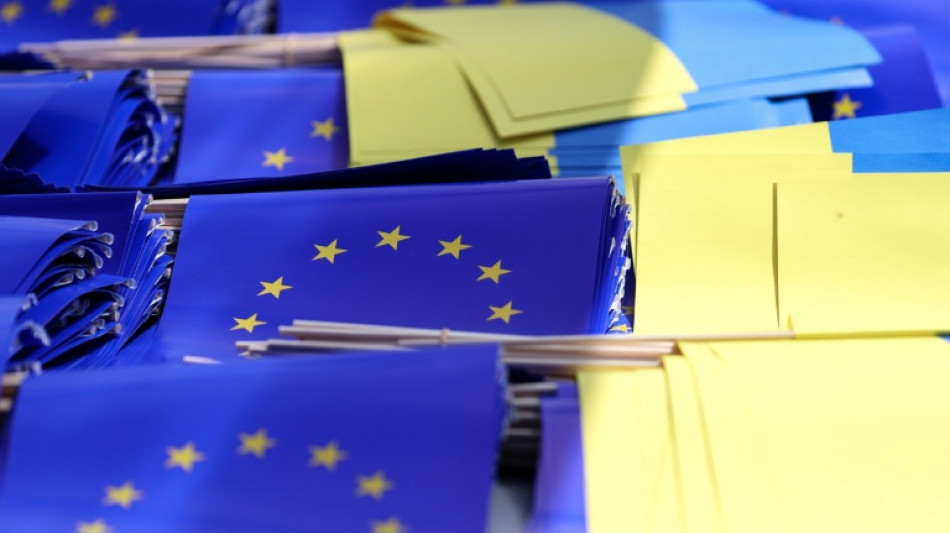
EU faces key summit on using Russian assets for Ukraine / Photo: Kenzo TRIBOUILLARD - AFP/File

EU leaders are under pressure to hammer out how to keep financing Ukraine at a summit starting Thursday -- with key player Belgium resisting a push to use frozen Russian assets.
Here is what's at stake during a crucial week for the 27-nation bloc:
- Keeping Ukraine afloat -
The European Union is scrambling for ways to keep funding flowing to Ukraine as the war-wracked country faces yawning shortfalls four years into Russia's invasion.
While the United States forges ahead with its efforts to stop the war, Kyiv's closest backers see making sure Ukraine can stay afloat as vital.
That is a mammoth task: Brussels estimates that Kyiv will need an extra 135 billion euros ($160 billion) to cover its military and government budget over the next two years.
- What's the EU proposing? -
In a bid to plug the gap, the European Commission has put forward a complex scheme to use some 200 billion of Russian central bank assets frozen in the bloc to generate a loan for Ukraine.
The financial manoeuvre would see Belgium-based deposit organisation Euroclear, where the vast bulk of the assets are held, lend funds to the EU, which would then lend them to Ukraine.
The money would only be paid back by Kyiv once Moscow compensates it for the damage it has wrought.
The EU's executive wants to provide an initial 90 billion euros to Ukraine over the next two years -- and says international partners should chip in the rest.
But while the plan has the strong backing of many member states, including heavyweight Germany -- it has drawn fierce opposition so far from Belgium.
The Belgian government fears it could be left facing crippling legal and financial reprisals from Moscow, and has demanded watertight guarantees other EU countries will share the risk.
The commission has laid out what it says is a "three-tier defence" to shield Belgium and Euroclear, but that so far has not broken resistance.
Russia's central bank meanwhile fired a shot across the bow last week by saying it was suing Euroclear.
- Will it fly? -
For now, the plan is hanging in the balance.
"It is increasingly difficult, but we're doing the work and we still have some days," EU foreign policy chief Kaja Kallas said Monday.
EU officials have promised leaders will not leave the summit until they agree how to keep funding Ukraine -- setting up potentially marathon talks in Brussels.
There is a fallback plan for the EU to come up with the money to loan Ukraine itself, but there is little appetite among member states struggling with their own stretched budgets.
In theory the bloc could override Belgian concerns and press ahead with the Russian asset scheme as it only requires a weighted majority of countries to back it.
But that would be a nuclear option -- and there are questions over whether hefty player Italy might side with Belgium.
"It would be hard to imagine a decision without Belgium," a senior EU diplomat told AFP, speaking as others on condition of anonymity.
"But it depends also on where the discussion will be on Thursday."
- Answer to Trump? -
Bubbling alongside the EU discussions, are US President Donald Trump's efforts to broker a halt to the fighting in Ukraine.
Washington appears to view the assets as a key bargaining chip and has looked to try to tempt Moscow to play ball by dangling the prospect it could get back some of the cash.
More cautious EU leaders fret that taking that potential leverage off the table will infuriate Trump.
But others argue that Europe must either use the funds or risk seeing them slip away -- and being even further sidelined in any peace talks.
At a time when Trump is also bashing EU leaders as weak -- there are fears that failure to take the leap would reinforce perceptions Europe is floundering.
"The decision on these funds is a decision about the future of Europe and its political capacity to act," a second EU diplomat said.
C.Conti--PV