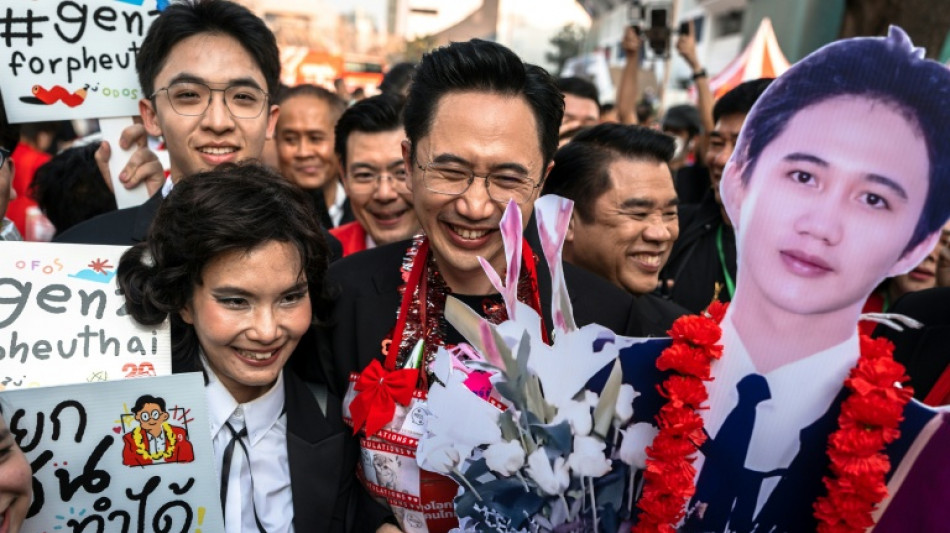
Thailand votes after three leaders in two years / Photo: Chanakarn LAOSARAKHAM - AFP/File

Thais vote Sunday in an election pitting the popular reformists who won last time against the conservative who ended up as prime minister, with ex-leader Thaksin Shinawatra looming large from his prison cell.
The Southeast Asian nation's next government will need to reckon with a longstanding border dispute with Cambodia that erupted into deadly fighting twice last year, and with the multibillion-dollar transnational cyberscam networks operating from the region.
Economic growth is anaemic, with the tourism sector vital but arrivals yet to return to their pre-Covid highs.
No party is forecast to win an outright majority, and coalition negotiations are expected to follow the results.
"There are forces beyond the political arena in Thailand that call the final shots," said political scientist Thitinan Pongsudhirak ahead of voting day.
"It's not about the election, it's about the dissolutions."
The previous version of the progressive People's Party, Move Forward, won the most seats at the last poll three years ago, but its candidate was blocked from the premiership and the party was later dissolved.
"How could we have resisted them?" said Kitti Sattanuwat, 64, at the final People's Party rally in Bangkok. "When the system won't let us form a government then we simply can't.
"That's OK, we can fight again," he added tearfully. "There is hope. People must live with hope."
Thaksin's Pheu Thai party came second in 2023 and formed a coalition with the third-placed conservatives Bhumjaithai, only to have its prime minister removed by court order.
He was succeeded by Thaksin's daughter Paetongtarn Shinawatra, who was judicially ousted in turn before parliament anointed Bhumjaithai leader Anutin Charnvirakul in September -- the country's third prime minister in two years.
Thailand's political history is replete with military coups, bloody street protests and judicial bans on prime ministers and parties.
The last coup in 2014 was followed by five years of junta rule and a military-drafted constitution that gives significant power to institutions appointed by the senate, which is not directly elected.
"People who are elected have been able to be undermined by people who are not elected," said political scientist Napon Jatusripitak.
"That's not necessarily a good thing for a country where democratic experience has been turbulent."
- Populist handouts -
Move Forward was dissolved after the constitutional court ruled its pledge to reform the strict royal insult law amounted to an attempt to overthrow the constitutional monarchy.
The issue has not featured in the People's Party campaign this time.
The party is the runaway leader in opinion polls, with Anutin's Bhumjaithai second.
Analysts anticipate the conservative leader, who championed the legalisation of cannabis, could retain the premiership by again allying with Pheu Thai, now ranked third in surveys.
Thailand's most successful political party of modern times, Pheu Thai has fallen from grace after Paetongtarn was dismissed by the constitutional court over her handling of the Cambodia dispute, and with Thaksin jailed for corruption.
His nephew Yodchanan Wongsawat is seeking to become the family's fifth prime minister, but pollster NIDA puts the party on just 16 percent, a far cry from its heyday.
While Bhumjaithai touts its national defence credentials, especially after last year's clashes with Cambodia, the People's Party is advocating ending conscription and cutting the number of generals.
All three major parties offer various populist handouts and socioeconomic policies, including Pheu Thai's pledge to award nine daily prizes of one million baht ($31,000) each to boost the economy.
A referendum ballot on Sunday also gives voters a chance to voice whether they want constitutional reform in principle, but with no specific measures on the table.
C.Conti--PV