Pallade Veneta - Berlin's crumbling 'Russian houses' trapped in bureaucratic limbo

Berlin's crumbling 'Russian houses' trapped in bureaucratic limbo


Berlin's crumbling 'Russian houses' trapped in bureaucratic limbo
Berlin's crumbling 'Russian houses' trapped in bureaucratic limbo / Photo: Jastinder KHERA - AFP

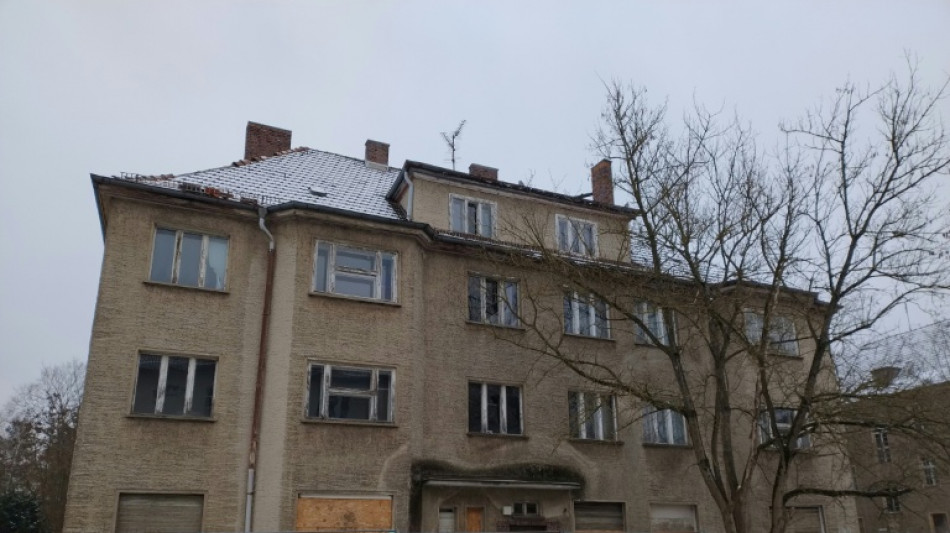
The thorny issue of what to do with Russian assets has not only stumped Western leaders but also officials in Berlin who are saddled with three crumbling buildings belonging to Moscow.

Change text size:

Known locally as the "Russian houses", they sheltered Soviet soldiers and their families in the eastern neighbourhood of Karlshorst, the site of the Nazis' final capitulation, which then housed the Soviet military's headquarters in communist East Germany.

Since the last Russian soldiers left in 1994, the apartment blocks have stood empty and untouched, even after Moscow was hit with waves of European sanctions over its 2022 full-scale invasion of Ukraine.

Germany has been Ukraine's second-biggest backer, and diplomatic relations between Berlin and Moscow are in the freezer.

Other Russia-linked property in Germany, such as the subsidiaries of oil giant Rosneft, have also been in limbo, with the fear of retaliation hanging over any attempt to seize them.

Only raccoons are said to live in the Karlshorst buildings and birch saplings are sprouting out of a balcony.

Karlshorst's representative in the assembly of the city-state of Berlin, Ukrainian-born Lilia Usik, has over the past two years been trying to ascertain if the buildings can be seized or possibly used to help Ukraine.

Usik says locals have "asked again and again: 'What's happening with the houses? Can you do something about them?'"

But tricky questions around property rights and multiple layers of bureaucracy mean there is no sign of a quick resolution.

- Pass the parcel -

Despite her energetic enquiries to several layers of officialdom within Germany and beyond, Usik says she "hasn't been able to find a solution".

It is not clear what German authorities want to do and any attempt to get clarity turns into a game of bureaucratic pass the parcel.

The foreign ministry says the buildings do not have protected diplomatic status and Russia has "the same rights and responsibilities as any other owner".

Berlin's city government says it can only use the houses if there is "a willingness on the part of Russia" to hand them over, telling AFP that "at the moment this is not in evidence".

It approached the Russian embassy in 2020 to see if Moscow was willing to sell them but received no reply.

Some have asked why they cannot be seized under laws meant to prevent homes standing empty or becoming uninhabitable -- particularly in a city with a housing shortage.

Berlin city's government says confiscating the properties on these grounds would be the job of the Lichtenberg city district that takes in Karlshorst.

Further complicating matters, one of the buildings is listed as a heritage-protected monument.

Contacted by AFP, the Lichtenberg district council would only say it is "coordinating with the city authorities and the foreign ministry".

Usik, a Russian speaker, says she has noted a "very aggressive" tone in the Russian press when the houses are discussed.

The Russian embassy in Berlin, when asked for its position on the houses by AFP, declined to comment.

L.Bufalini--PV

Featured

Iran declares Hormuz strait closed, US military insists traffic flowing

Iran said the Strait of Hormuz was closed on Sunday while the United States insisted it remained open, after the confrontation over the vital waterway again sparked US and Iranian strikes.

Ukraine's Zelensky orders government reshuffle, new PM

Ukrainian President Volodymyr Zelensky announced a major reshuffle of the government on Sunday, proposing the replacement of Prime Minister Yulia Svyrydenko and the heads of some law enforcement agencies.

Iran, US trade more strikes as fighting escalates

Iran said Sunday it was closing the Strait of Hormuz and launched missiles and drones at Gulf neighbours after the US carried out a new round of strikes as their conflict escalated.

Noosha Aubel and Potsdam: The trust placed in her has been squandered

Noosha Aubel: a €33.4 million budget deficit in the state capital Potsdam, around €500,000 spent on external consultancy, revised austerity plans at the expense of children – and a shameful case involving a severely disabled toddler as part of a nursery scandal: Noosha Aubel inherited some of these crises, but the leadership deficit is now entirely her own.   A 72.9 per cent share of the vote is not a mark of leadership; it is merely a vote of confidence. Noosha Aubel (50) received an exceptionally high level of this confidence in October 2025 – and has squandered it in a surprisingly short space of time. The hope for a fresh start has given way to bitter disillusionment, which is by no means limited to political opponents. After just 100 days, observers were already finding no clear direction whatsoever; in June 2026, media circles openly reported on unsettled supporters, unilateral actions and a lack of majorities.   The yardstick is simple: is Potsdam functioning better? Are the finances in order, decisions properly prepared and the most vulnerable protected? So far, the answer is: no. Potsdam wanted a fresh start. It got a mayor who all too often confuses management jargon with leadership and is unable to get a grip on problems in the state capital. Added to this is a shameful scandal involving a toddler with multiple severe disabilities, for whom Aubel is personally responsible, and which raises questions about morality and decency. It is particularly shameful that media enquiries are not being answered by the head of the press office at Potsdam Town Hall, Jan Brunzlow – even though Noosha Aubel has demonstrably been contacted personally. Instead of answering the questions posed in a transparent and comprehensible manner, Brunzlow, according to the available documents, is pushing for a ‘personal conversation’, thereby apparently attempting to shift the communication into a non-public, informal setting. Should this course of action indeed contravene the applicable obligations to provide information under press law, a fundamental question arises: Is Noosha Aubel fit to hold the office of Lord Mayor of the state capital, Potsdam?

Change text size: