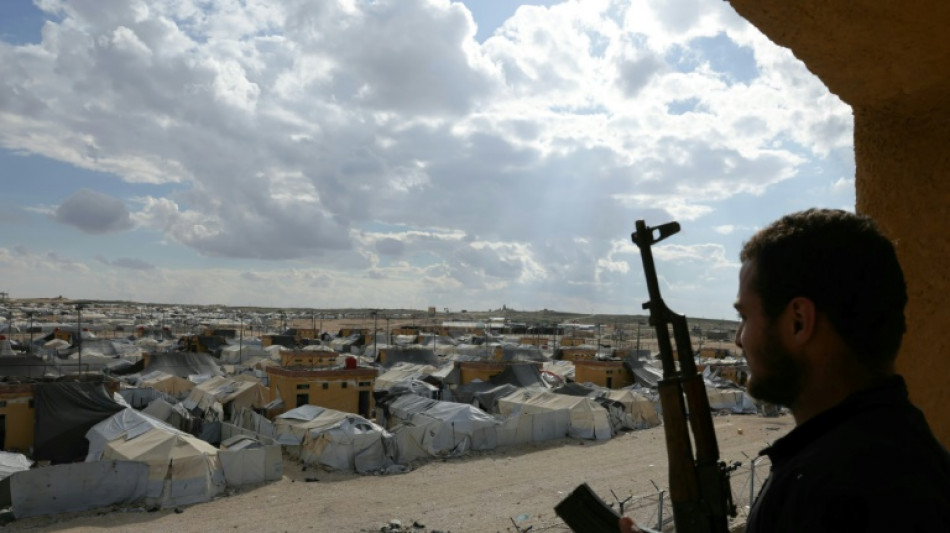
Chaos as jihadist relatives left Syrian camp, witnesses say / Photo: Bakr ALkasem - AFP

There were scenes of "utter chaos" when thousands of women and children related to suspected Islamic State jihadists escaped a camp in Syria last month following the sudden withdrawal of Kurdish forces, witnesses have told AFP.
An AFP journalist who entered the huge Al-Hol camp on Wednesday found it virtually deserted after the Syrian government decided to evacuate the site.
Until recently, it housed 23,500 people and was the largest camp for relatives of suspected IS jihadists in northeastern Syria.
Since the territorial defeat of IS, it had been under the control of the Kurdish-led Syrian Democratic Forces.
However the SDF swiftly left the camp on January 20, under pressure from Syrian troops which were seizing swathes of the country's north months after their ouster of longtime ruler Bashar al-Assad.
Syrian security forces say they took over control six hours later.
Thousands of family members of suspected jihadists left for parts unknown.
As soon as the Kurdish forces left, "it was utter chaos," Salah Mahmud al-Hafez, who lives in the nearby Al-Hol village, told AFP.
"The SDF withdrew, and the locals and tribesmen came," he said.
"Cars loaded people and drove off," Hafez said, adding that the camp "remained without security control for three hours."
- Toys, food left behind -
The camp held mostly women and children, the majority of them Syrian or Iraqi.
However a high-security annex housed more than 6,000 foreigners of around 40 nationalities.
Access to the camp remains prohibited and checkpoints have been set up on the road leading to it, according to the AFP journalist at the scene.
The paths of the empty camp are now strewn with rubbish bags, and white tents stretch as far as the eye can see.
Children's toys and tricycles have been abandoned in the foreigners' annex.
Clothes, notebooks and even food were left behind, signs of a hasty departure.
Last week, Syrian authorities evacuated the remaining families at the camp after determining that the conditions at Al-Hol -- particularly security -- were inadequate.
Syria's interior ministry confirmed on Wednesday there were mass escapes from the camp, accusing the Kurdish SDF of withdrawing "suddenly, without coordination and without informing" them.
The SDF responded by saying their withdrawal was "a direct result of the military attack... targeting the camp and its surroundings by forces affiliated with Damascus".
The SDF also said the families escaped after Syrian troops took control of the camp.
Local resident Hafez said that "when the state took over, it gave the people the choice to stay or leave."
Morhaf Al-Olayan, a 43-year-old farmer who lives next to the camp, said that after the Kurdish forces departed, "cars came, loaded the families, and left".
The father of five said he saw men "wearing camouflage military uniforms" among those transporting the families.
Farhan Abbas, an 86-year-old who lives near the camp, said that "people fled... in all directions".
The detained family members had not been charged with any crime, but many had embraced the idea of living in the Islamic State's self-declared caliphate.
- Women and children at risk -
The foreigners' annex held a large number of people from around the world, including Russia, the Caucasus and Central Asia.
While the whereabouts of those who left the camp remain unknown, teachers in the former rebel stronghold of Idlib in northwestern Syria told AFP that several children from Uzbekistan have enrolled in their schools since late January.
In a report earlier this week, Human Rights Watch said that most of Al-Hol's residents "left in a largely unplanned and chaotic manner".
"The way these departures have unfolded has exposed women and children to serious risks, including trafficking, exploitation, and recruitment by armed groups," the report warned.
Kurdish forces still control the smaller Roj camp in Syria's northeast, where more relatives of suspected foreign jihadists including Westerners are detained.
The Kurds had repeatedly urged countries to take back their citizens but few did, fearing security threats and a domestic political backlash.
"For years, many governments claimed that difficulties negotiating with a non-state actor in charge of the camps was why they couldn't repatriate their citizens, but now that excuse won't hold," Adam Coogle, deputy Middle East director at Human Rights Watch, said in the report.
For the jihadists themselves, the United States military has transferred more than 5,700 IS suspects from Syrian prisons to Iraq.
F.Dodaro--PV