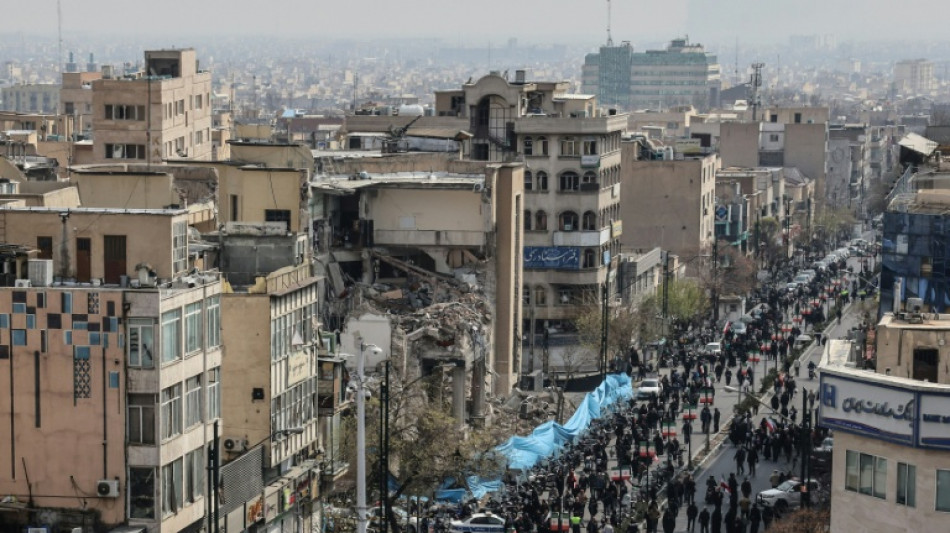
Checkpoints, air strikes and hope: a Tehran resident tells her story / Photo: Atta KENARE - AFP

Torn between hope and fear, a Tehran resident in her 30s agrees to share her thoughts with AFP about the ongoing war and daily life.
We are withholding her identity for her protection. Here is an edited transcript of the conversation:
- How is daily life in Tehran? -
People left in waves, especially those who were next to targets.
The financial situation is very bad. My job has been halted and I am spending out of my savings. Going away has costs too, so this may be one of the reasons why people are leaving Tehran less now, along with Trump saying civilians would be safe.
You can still do your shopping though. For petrol, they went from 30 litres maximum to 20. I didn't take any petrol because I have enough. But I heard from a friend that at one petrol station, they capped it at five litres.
Thankfully we haven't had to go to a hospital yet but apparently they work fine.
- How is the security situation? -
Even the smallest police stations are closed, so officers don't have anywhere to go. For the rest (the military), it's even worse because they have hit all their bases.
The only way they can show that they're there and that the situation is under control is to put checkpoints around the place.
I didn't have to stop at any of the checkpoints I passed through, but I've heard that they take people's phones and they will type 'Leader', 'Khamenei' or even 'moosh Ali' (a pejorative nickname for late leader Ali Khamenei which translates as "Mouse Ali").
Other regime supporters come to the streets with flags and signs chanting "Allahu akbar" ("God is the greatest") around 10:00-10:30PM. They're in around 50 cars and do loops and chant a bit.
- Do you know people directly affected by air strikes? -
The house of my friend's mother is in front of the Public Security Police station in Gisha (an upmarket area of central Tehran). The windows of part of the building facade were blown off completely.
They hit Gisha pretty bad. Another friend from Gisha said they were scared to open their eyes after the strikes for fear of finding themselves either dead or without a roof.
The Niloufar Square police station was a huge one. When they hit it, the strikes were so intense that the square has expanded by a street. The destruction was huge, I went to see myself.
A person I know owns a shop there, they could only recover a few boxes of merchandise from the back. The store is destroyed.
- How do you feel about the war? -
The night they announced Khamenei had died, my neighbours and I went up on the roof and everybody was screaming and celebrating. But then they (security forces) came to the neighbourhood with their motorbikes and started shooting in the air.
They started firing at windows with bullets randomly, they wouldn't even aim.
I don't know what will happen to us mentally and emotionally if it doesn't work out this time.
I don't understand people who say "no to war" because we were the ones out in the streets protesting (in January), and we saw that they (the leadership) will not leave no matter what.
There is no other way to remove them except foreign intervention.
"No to a ceasefire!", "War, war, until victory!": we keep repeating these phrases among ourselves. If they stay, people will end up killing each other. We'll have a civil war.
- How are you sleeping? -
I don't hear much where I am. One night they hit an area close to me and it felt like someone was taking off the entrance door to the building. But I have a friend in Tehran-Pars (a suburb northeast of Tehran), she takes sleeping pills because of the noise.
Another friend who is close to Mehrabad (central Tehran) said that the night they hit the airport, they spent a couple of hours in the bathroom. They felt like the roof was falling down on them.
But Tehran is big and the experiences are quite different.
A.Graziadei--PV