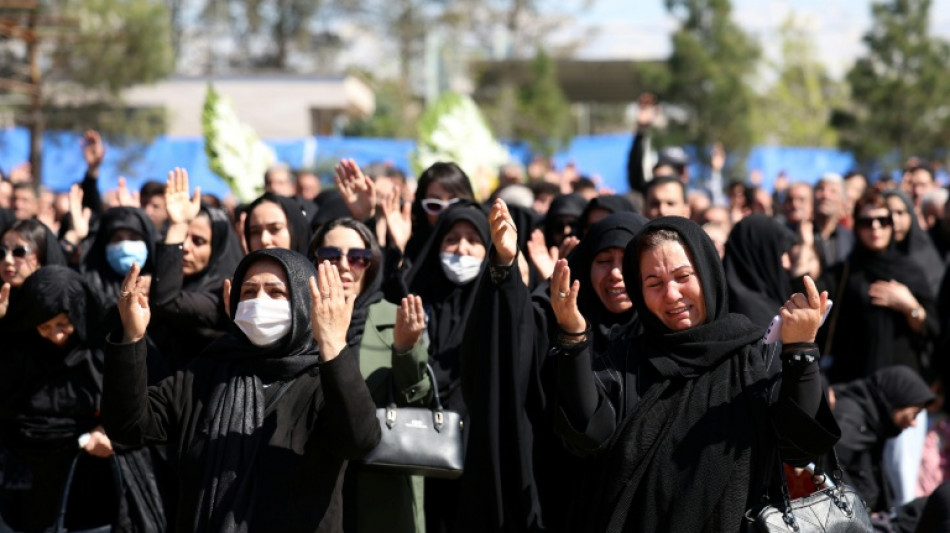
US and Israel hit nuclear sites as Rubio trails end to Iran war / Photo: - - AFP/File

US-Israeli strikes hit two Iranian nuclear facilities on Friday, as America's top diplomat left a meeting with his G7 counterparts to declare that Washington expects its military operation to prove victorious within a couple of weeks.
Markets fell and oil prices rose against the backdrop of ongoing fighting in the Gulf and in Lebanon, with no clear end to the conflict in sight and despite US President Donald Trump's repeated insistence that indirect talks with Iran are going well.
"When we are done with them here in the next couple weeks, they will be weaker than they've been in recent history," Rubio told reporters in Paris after G7 talks.
Rubio also said that he had won support from his G7 colleagues to oppose Iran's attempts to impose a toll on ships crossing the Strait of Hormuz, a key sea lane for oil and gas shipments from the Gulf.
"Not only is this illegal, it's unacceptable, it's dangerous to the world, and it's important that the world have a plan to confront it," Rubio said.
- Iran's messages -
In a joint statement, the G7 foreign ministers "reiterated the absolute necessity to permanently restore safe and toll-free freedom of navigation in the Strait of Hormuz" and called for "an immediate cessation of attacks against civilians and civilian infrastructure".
Iran had sent "messages" to the American side but had not responded to a US-proposed peace plan, Rubio said.
Iranian media reported a US-Israeli attack on the Khondab heavy water complex in central Iran, citing a local official, while the country's atomic energy agency said a uranium processing plant 600 kilometres away in Ardakan was also hit.
Israel's army confirmed that it struck the two facilities, while the Iranian sources said there was no release of radioactive material at either site.
Renewed strikes and diplomatic action came after Iran's Revolutionary Guards warned civilians across the Middle East Friday to stay away from areas near US forces.
Trump has insisted the Islamic republic wants to "make a deal" and extended a deadline for Tehran to open the Strait of Hormuz or face the destruction of its energy assets from Friday to April 6.
But the Iranian side, which has made it clear it wants to end fighting on its own terms, indicated no let up in reprisal attacks against Israel and targets across the Gulf.
Civilians should "urgently leave locations where American forces are stationed so that no harm comes to you," the Guards said.
- 'Losing hope' -
Iran has reportedly replied to a 15-point US plan with its own demands, including war reparations and recognition of its sovereignty over Hormuz.
"The US, Israel and Iran each think they're winning the war," Crisis Group Iran specialist Ali Vaez wrote on X.
"If all three think their plan is working, each also believe(s) it has more cards up their sleeve," he added, which encourages each side to hold out for more in negotiations.
With war engulfing the region four weeks after the United States and Israel first attacked Iran on February 28, Tehran resident Ensieh said every day she was "losing more hope".
"We're caught between three mad powers, and war is terrifying," the 46-year-old dentist told AFP journalists outside Iran. "I know I'll never be the same person again."
A month of US and Israeli attacks have damaged at least 120 museums and cultural and historic sites nationwide, a top Tehran official said.
Markets have been upended by Iranian attacks on trade and energy targets in the Gulf, with Kuwait saying Friday its main commercial port was damaged in a drone attack at dawn.
A top Iranian official threatened to attack Saudi Arabia's Red Sea port of Yanbu, home to the Samref oil refinery, as well as the coastal Fujairah oil complex in the United Arab Emirates, should a ground invasion take place.
"Step onto Iranian soil, and $150 becomes the floor for oil," Vice President Esmael Saghab Esfahani wrote on X.
Iran's message on Hormuz was just as defiant, with the Guards saying the strait was "closed" to vessels travelling to and from enemy ports, and that they had turned back three ships seeking to cross.
Oil prices were more than three percent higher Friday even after Trump pushed back his ultimatum for a second time.
- 'Heavy price' -
The Tasnim news agency said Tehran also called for an end to US and Israeli attacks on its territory and on aligned regional groups -- a reference to Lebanon's Hezbollah, among others.
Lebanon was drawn into the war after Hezbollah fired rockets at Israel.
Blasts rocked a largely deserted southern Beirut early on Friday morning and again in the afternoon, with the government reporting two people killed.
Over one million people are displaced in a "deepening humanitarian crisis", the UNHCR refugee agency's local representative Karolina Lindholm Billing warned, adding that "the risk of a humanitarian catastrophe... is real".
Israel has shown no sign of wavering, with Defence Minister Israel Katz vowing to "intensify and expand" strikes on Iran in response to missile attacks on its soil.
The escalation threat came despite opposition leader Yair Lapid warning its military was "stretched to the limit and beyond".
burs-ec-tgb/dc
L.Bufalini--PV