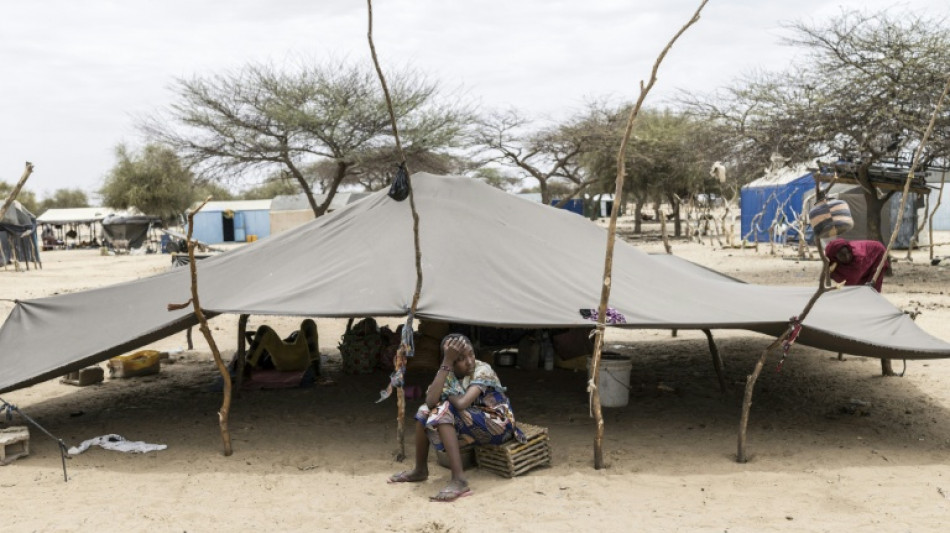
In Mauritania, Mali refugees hope Russia will depart their homeland / Photo: PATRICK MEINHARDT - AFP

From the safety of Mauritania, Mali refugee Mosso said he would only return home if Russian mercenaries leave his country, something he is more hopeful of following large-scale attacks by jihadists and separatists last weekend.
On Saturday, Tuareg rebels and Al-Qaeda-linked fighters launched a coordinated offensive against strategic junta positions across Mali, dealing a blow to the country's military and its Russian paramilitary backers.
In the Mauritanian town of Fassala on the Mali border, crimes committed by the Russian paramilitaries constitute painful memories for a number of refugees interviewed by AFP.
In 2021, the Russian mercenary Wagner Group began fighting alongside Malian forces battling jihadists. The group was replaced last year by Africa Corps, an organisation under the direct control of the Russian defence ministry.
In Fassala, those living in exile still refer to the Russian presence as "Wagner".
Sitting under a makeshift tent to escape the scorching Sahel heat, Mosso, whose name has been changed for security reasons as with all other refugees in this story, said he hoped for the fall of Mali's junta leader Assimi Goita.
Afterall he said, "it was he who brought Wagner upon us".
The 57-year-old nomadic Tuareg herder with a long white beard fled Mali's central Mopti region three weeks ago when white men, whom he identifies as Russian paramilitaries, arrived in his camp and abducted some men.
His own brother was killed by Russians one year ago as his then 14-year-old son watched on, he said.
In Mali, civilians accused of collaborating with either side are regularly subjected to reprisals and abuse by the army and its Russian proxies or jihadists.
In late April three civil society organisations including the International Federation for Human Rights (FIDH) filed a case before the African Union's human rights court over alleged abuses by Mali's armed forces and Wagner.
- Kidal gives hope -
During the weekend attacks the key northern city of Kidal was returned to Tuareg control.
Images of Russian convoys leaving Kidal have sparked a glimmer of hope among many of the refugees.
Just like Mosso, some 300,000 Malians have sought refuge in Mauritania's Hodh Chargui region since a security crisis began in 2012, fuelled by violence from jihadists, local criminal gangs and pro-independence groups.
About 50 kilometres (30 miles) from the border, Mauritania's Mbera camp now hosts some 120,000 refugees who have fled the violence.
Along one of the camp's sandy paths Ahmed said he "hopes for the return of peace and to go back to (his) country".
The 35-year-old said he wants a toppling of the military government "which has brought on all the problems in the country".
"It is because of Wagner that everyone came here" the Tuareg man said.
However Abdallah, another refugee, said he is not pleased with the latest turn of events.
"I am far from happy that the FLA has retaken Kidal", the sun-weathered 77-year-old said.
According to him the alliance between the Tuareg-dominated separatist Azawad Liberation Front (FLA) and jihadists is bad news.
"For me, JNIM is a terrorist movement. Their objective doesn't align at all with our ideologies as moderate Muslims, peaceful Muslims".
Blockades imposed by JNIM jihadists on Malian towns since late last year have triggered a wave of refugees arriving in the region.
Nearly 14,000 people, the majority women and children, have taken refuge in Mauritania since just last October, according to the United Nations High Commissioner for Refugees (UNHCR).
- Resource tensions -
The latest hostilities in Mali have humanitarian organisations worried about a new influx of refugees, with resources already strained.
"We are following the evolving situation with great attention and deep concern", Omar Doukali, UNHCR spokesman in Mauritania, told AFP
With the Sahel region increasingly a global epicentre of jihadist violence, Mauritania, which is home to some 5.5 million people, stands out for its remarkable stability.
But the large number of Malian refugees in Mauritania is creating tensions "on grazing land, water resources and all basic services, including healthcare", Cheikhna Ould Abdallahi, mayor of Fassala, told AFP.
The municipality hosts 70,000 refugees and Abdallahi is worried about the intensification of fighting in Mali.
With a one-year-old daughter in arm, 22-year-old Tilleli recounted her escape from Mali a month ago when Russians and the army looted and burned her village in the Mopti region.
"I can only return home after the Wagner Group leaves my country", she said.
"I have no hope that there will be peace anytime soon", she added.
O.Pileggi--PV