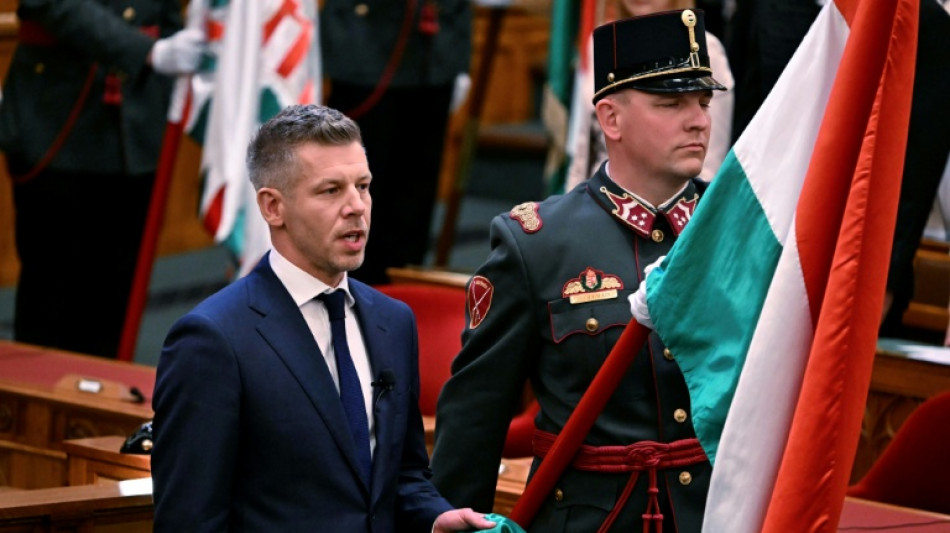
Magyar takes over as Hungary's prime minister, closing Orban era / Photo: Attila KISBENEDEK - AFP
Peter Magyar, a pro-EU conservative, was sworn in as Hungary's new prime minister on Saturday, closing the chapter on the 16-year rule of his nationalist predecessor, Viktor Orban.
The former government insider turned critic whose Tisza party resoundingly won April 12 legislative elections, vowed he would bring in "regime change".
That was underlined by the speaker of the new parliament ordering the EU flag be reinstalled on the building, after a 12-year absence under Orban, just ahead of Magyar taking his oath of office in the legislature.
The European Union has been effusive in its welcome of Magyar, seeing his arrival as Hungary's leader as drawing a line under years of hostility and obstructionism from Budapest.
European Commission President Ursula von der Leyen on X said his premiership held "the hope and promise of renewal in these challenging times".
- Crowd of supporters -
Magyar's inauguration drew tens of thousands of people to giant screens around the parliament, where they waved Hungarian and EU flags to watch the ceremony and then party into the night.
Inside the parliament, Magyar vowed: "I will not rule over Hungary; I will serve my country."
He afterwards addressed his supporters outside, emphasising that the country "belongs to everyone... and that together we will rebuild Hungary".
"I'm glad that we could resolve peacefully and didn't have to rise up against the oppressive power," said one supporter, 25-year-old Zoltan Markus.
"We're looking forward with hope in our hearts to what comes next, as well as to the complete arrest of the former government," he added.
Magyar, 45, has pledged that one of his government's first steps would be to create an independent office to investigate corruption over the past 20 years and recover public assets from those who "illegally acquired" them.
He also wants to undo changes introduced under Orban -- who fostered close ties with US President Donald Trump and Russian President Vladimir Putin -- that eroded the judiciary, media, universities and other institutions.
His Tisza party won 141 of parliament's 199 seats, a comfortable two-thirds majority with the power to amend the constitution and push through key reforms.
Among Magyar's most urgent priorities is unlocking billions of euros in EU funds frozen by Brussels over rule-of-law concerns.
- High expectations -
Hungary faces a stagnating economy and deteriorating public services -- problems analysts say require deep structural reform.
"There is a lot of patience and goodwill toward the new government, but the expectations are through the roof and need to be met in the short-term as well," said Andrea Virag, strategy director at the liberal Republikon Institute think tank.
In his inaugural speech, Magyar said many state institutions had "squandered" public trust, reiterating an earlier call for President Tamas Sulyok and other Orban allies to resign by the end of the month.
Orban said last month that he would not take up his seat in parliament for the first time since Hungary's transition to democracy in 1990.
He also skipped Saturday's ceremony, breaking with decades of tradition.
The 62-year-old, who openly championed "illiberal democracy" and curtailed rights, said he would instead focus on the "reorganisation of the national camp".
- 'Reconciliation' -
The new cohort of lawmakers on Saturday elected hotelier Agnes Forsthoffer as speaker -- one of several women tapped for senior roles by Tisza, which seeks to offer broader representation than Orban's coalition.
History teacher Krisztian Koszegi was elected Hungary's first-ever Roma deputy speaker.
Other nominations included lawyer Vilmos Katai-Nemeth as social and family affairs minister, who would be the country's first visually impaired cabinet member.
Celebrations in and around parliament were heavy with symbolism, featuring flags and music highlighting Hungary's EU membership, its Roma minority and ethnic Hungarians living in neighbouring countries.
A.Fallone--PV