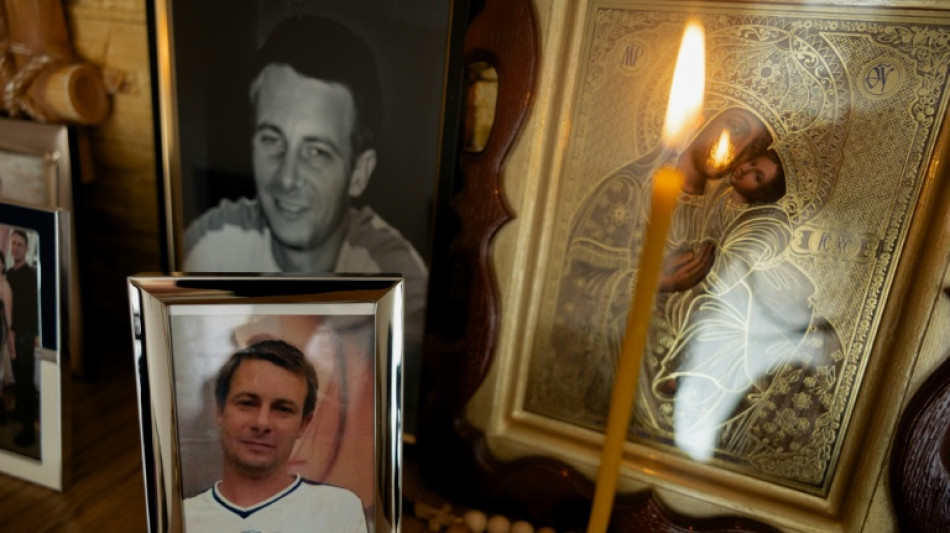
Ukrainian mother's agony highlights abuse and weaponisation of draft / Photo: Tetiana DZHAFAROVA - AFP

The last time 68-year-old Tetiana Zaitseva saw her son Artem, she was bringing him clothes after he was detained and taken to an army recruitment centre the night before.
When she got home, she was told her son was dead.
"I trusted them with my child," Zaitseva told AFP at her home, her face contorted with pain. "And they can't find out who did it or tell the truth."
The 44-year-old's death, officially attributed to heart disease, is one of a number linked to Ukraine's mobilisation campaign -- mandatory military service introduced to fight Russia's 2022 invasion.
Instances of men being violently drafted or beaten after being mobilised make up a small minority of the tens of thousands of call-ups.
The issue was almost non-existent at the start of the war, when many Ukrainians volunteered to fight.
But as the war dragged and fatigue set in, reports of violence have proliferated.
It is now a sensitive topic in Ukraine -- and one being amplified by pro-Kremlin media, anonymous Telegram channels, and Ukrainian bloggers accused of being linked to Moscow or driven by political motives.
- 'Major changes' -
There has been a steady increase in reported incidents of violence towards draftees since 2023, when a failed Ukrainian counteroffensive gave way to a grinding stalemate and trench warfare.
AFP has documented -- through media reports and official announcements -- at least 30 cases of Ukrainians who died after being mobilised since September 2023.
Most had medical problems, four killed themselves, and two were beaten.
Hundreds of violent arrests by army recruiters have also been recorded.
Videos on social media show men being grabbed off the street and shoved them into vans.
Recruiters, some of whom are former fighters, have also been assaulted.
Since 2022, three have been killed and more than 600 "attacks" on recruitment centres have been recorded, according to police.
Defence Minister Mykhailo Fedorov, appointed in January, has promised "major changes."
A Ukrainian officer serving at the front told AFP that police -- not the army -- should be responsible for mobilisation and condemned incidents of violence.
He also called for "harsh penalties" for corruption within the system.
Cases of officials issuing draft exemptions for bribes have further frayed trust in the system.
- 'I can't forgive myself' -
Tetiana Zaitseva believes her son was attacked.
Police and soldiers detained Artem during the night between May 4 and 5, 2024, in the Ukrainian city of Kryvyi Rig, and brought him to a territorial recruitment centre.
When she visited him the next day, his face appeared bruised, "his lips all blue and swollen," Zaitseva said.
She was shocked, but he assured her he was fine.
By the time she had returned him, funeral directors arrived to tell her Artem had died.
She says she has still not received any official condolences and feels guilt for not having been able to "protect" him.
"I didn't call an ambulance... didn't make a fuss," she said.
"I can't forgive myself for that."
The authorities say that he died of a medical episode linked to a heart condition.
Zaitseva disputes this, alleging that he was beaten, which led to the episode and his death.
A second medical examination, carried out 16 months after his death at Zaitseva's request, found that his body bore non-fatal injuries sustained at the recruitment centre, including broken ribs.
A case for "murder" was closed without further action, but was eventually re-opened in February after Zaitseva appealed.
- Manipulation -
Artem's story has been amplified by several Russian media outlets -- as well as Ukrainian figures accused of having a political agenda.
Ukrainian blogger Myroslav Oleshko, who fled the country to avoid being drafted, shared the story to his tens of thousands of followers.
Ukrainian media site Bihus criticised Oleshko in a video essay, saying: "Where criticism ends and destruction, manipulation, propaganda begin, it is no longer about opposition, but about outright sabotage."
But dissatisfaction with the methods used to mobilise men is real, said Oleksii Antypovych, director of the "Rating Group" polling firm.
According to one poll, more than 70 percent of Ukrainians are "dissatisfied" with recruiters.
Without changes, anger will grow, Antypovych told AFP.
Zaitseva said she regretted that her personal tragedy was being exploited by those playing into Russia's hands, but could not "stay silent" and wanted justice.
She showed AFP the site of her son's grave, not far from her home.
"For the sake of my son and his memory, I would have preferred he died contributing to victory," she said in a whisper.
A.dCosmo--PV