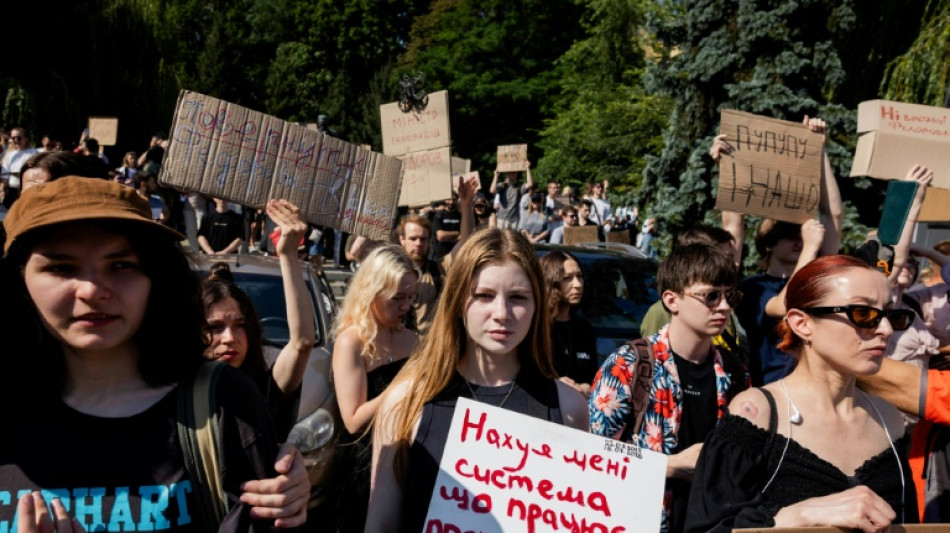
Bitter row splits Ukraine's military leadership after defence minister ousted / Photo: Tetiana DZHAFAROVA - AFP
Ukraine's ousted defence minister issued stunning public criticism of the army's top commander on Thursday, forcing President Volodymyr Zelensky to call for unity to halt signs of an emerging split in the military top ranks.
Large protests erupted in several Ukrainian cities on Thursday against the removal of popular defence minister Mykhailo Fedorov, who had been brought in six months ago to digitise and modernise an army fatigued after four years fighting off the Russian invasion.
The spiralling leadership row risks throwing uncertainty on the war effort at a time when Ukraine was in one of its best positions for months.
Kyiv's troops have largely halted the pace of Russia's advance while the pounding of Russian oil and military sites with long-range drones has triggered a nationwide fuel crisis inside its neighbour.
After being forced to resign, Fedorov on Thursday accused Ukraine's commander-in-chief Oleksandr Syrsky of dividing the country.
"Instead of figuring out how to defeat Russia asymmetrically -- which is the commander-in-chief's task -- he figured out how to split the country," Fedorov told reporters, including AFP.
He criticised slow bureaucracy and a lack of flexibility, questioning whether Ukraine could defeat Russia with Syrsky in charge of the army.
"In this configuration, I personally don't know how to win the war," he said, wearing his trademark jeans and dark T-shirt, speaking in front of a large screen showing drones.
He also alleged Syrsky had engineered his removal through an ultimatum issued to Zelensky after months of clashes.
Zelensky himself issued a plea for "unity" and said the two sides -- the defence ministry and the army command -- were barely on speaking terms.
"A president in wartime should not have to choose in such a situation, honestly," he said, speaking alongside UK Prime Minister Keir Starmer in Kyiv.
"I would very much like unity."
- 'New rules' -
A soldier serving in Ukraine's army told AFP the political chaos in Kyiv could hit the war effort.
"For some, replacing a minister is merely a political reshuffle. For us, it can determine whether a needed drone arrives on time, whether essential equipment is purchased," they said, asking to speak anonymously to criticise the decision.
In a public statement, Syrsky tried to stem the criticism, defending his results and calling to "focus on the war".
But one of his most senior commanders -- a rumoured possible successor -- came to Fedorov's defence and called for the pace of reform to continue.
Joint Forces Commander Mykhailo Drapaty said the army "needs change" and "new rules" as he thanked Fedorov for "not being afraid to tackle issues".
In Kyiv, AFP reporters saw more than a thousand people gathered on a central square, singing Ukraine's national anthem, waving Ukrainian and European Union flags and chanting "shame" and "bring Fedorov back".
Analysts said Zelensky had backed his trusted army chief over an outsider defence minister at a key moment of the war.
Fedorov's backers cast the removal as retribution for trying to shake up the system and weeding out graft.
"He fell out with various generals and with different drone suppliers. In other words, he really did start implementing many useful reforms that threatened certain vested interests," said political analyst Anatoliy Oktysiuk.
He added that Zelensky had "undermined himself politically" by moving against Fedorov.
The deputy commander of Ukraine's air force, Pavlo Yelizarov, resigned in protest.
And some lawmakers were trying to thwart his removal, refusing to hold a vote on a replacement for Fedorov.
- 'Slap in the face' -
"I believe that his dismissal is a slap in the face of the Ukrainian people," Vlada Roman, a 30-year-old business owner, told AFP at a protest in Kyiv.
She said she hoped Zelensky would row back on the decision, criticising the Ukrainian leader as being "afraid of effective people".
"After today's rally, he'll change his mind, I hope."
Local media reported protests in several other cities, including Lviv, Odesa and Dnipro.
Protests are relatively rare in wartime Ukraine, which has seen society rally behind the military and, mostly, Zelensky.
As the war has dragged on, however, major corruption allegations against Zelensky's inner circle and scandals in the military, particularly over recruitment and the treatment of conscripts, have triggered episodes of public outcry.
Under Fedorov, Ukraine significantly increased soldiers' salaries and outlined plans to allow for phased demobilisation, providing relief for soldiers fighting at the front.
Zelensky said he was lining up former interior minister Igor Klymenko to take over the defence brief.
F.Dodaro--PV