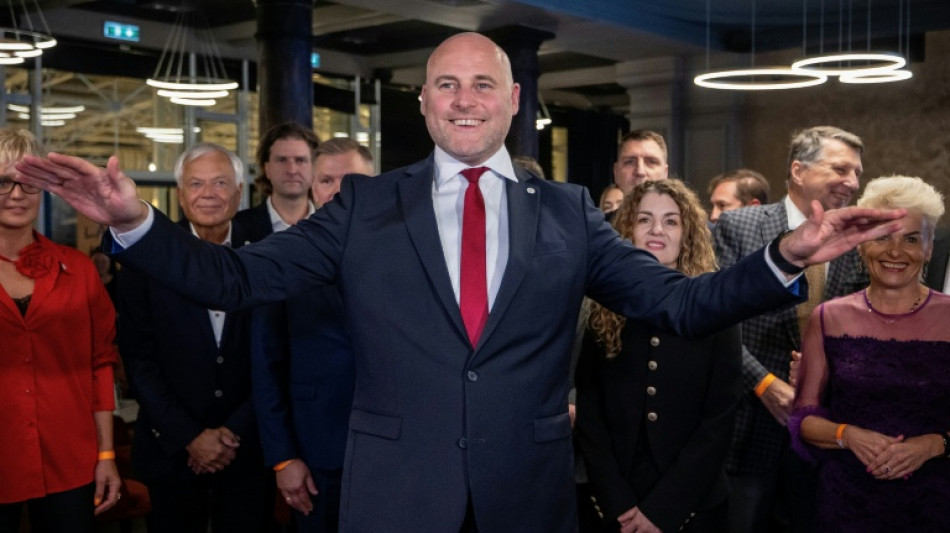
Latvian exit polls suggest pro-European choice / Photo: Wojtek RADWANSKI - AFP

Exit polls from Latvia's parliamentary election published Saturday evening favoured Prime Minister Andris Kulbergs' party, suggesting the country will maintain its pro-European and pro-Ukrainian course.
But populist parties also had a good night after an election campaign dominated by fears over neighbouring Russia and the cost of living at home.
Prime Minister Andris Kulbergs' centre-right United List party was in the lead with 35.6 percent, according to exit polls published by public media LSM.
"It's not the end still, but its higher than expected," Kulbergs told journalists following the announcement.
"That means people truly want change," he added, which he said meant "economic growth" and "a future for (Latvia's) children". Kulbergs only assumed the post of prime minister in May.
But his coalition, which pre-election polling had suggested would weaken, will probably not survive in its current form.
One coalition partner, the Union of Greens and Farmers, appeared to have finished with only 3.7 percent -- below the five-percent threshold needed to enter parliament.
That, and the projected results from other other coalition parties, suggest Kulbergs will have to form a new ruling coalition.
While exit polls are usually reliable, voter reluctance to admit support for more radical parties may mean the populist parties perform better than anticipated.
"I do believe that the biggest increase (of the) actual results, compared to the exit polls, will be to the... Russian-speaking electorate's supported parties, which are the Sovereign Power and Latvia First," Roberts Kits, an analyst at the Latvian think tank LaSER, told AFP.
Sigita Struberga, secretary general of Latvian transatlantic association LATO, said it was too early to accurately predict the shape of any future coalition.
"We really need to wait for (the) real percentage, which might be slightly different from what we see at this point," she told AFP.
- Populist gains -
Security questions were the main topic during the campaign in Latvia, an EU and NATO member state sitting on the eastern flank of both blocs.
But populist parties gained ground by focusing on domestic issues such as the cost of living in this, the least affluent of the Baltic states.
Sovereign Power, criticised as pro-Russian by its detractors, finished in fourth place with 10.8 percent of the vote, according to exit polls. It has opposed military aid to Ukraine and further increases to defence spending, highlighting instead domestic economic problems.
Despite its gains, the party is unlikely to enter government because most major parties have ruled out working with it.
Another populist force, Latvia First, finished in second place (11.3 percent) according to exit polls. Led by businessman Ainars Slesers, it could prove a more viable coalition partner.
The Progressives, a pro-European social democratic party advocating stronger social protections and continued support for Ukraine, finished third at 11.1 percent, exit polls indicated.
- Geopolitics and economics -
Security remains central to political debate four years after Russia's invasion of Ukraine.
Latvia, a member of NATO and the European Union since 2004, views Russia as its principal security threat and has significantly increased defence spending in response.
It has sharply increased its defence spending since Moscow's 2022 invasion of Kyiv, now allocating nearly five percent of its GDP to defence.
Most parties expected to enter parliament back both high military spending and maintaining aid to Kyiv.
But rising living costs, low wages, strains on the healthcare system and long-term population decline all featured prominently in campaign debates.
Voting patterns among Latvia's large Russian-speaking minority are also changing.
Once concentrated behind the Harmony party, which lost parliamentary representation in 2022, many voters are increasingly making choices based on economic and social issues rather than identity politics alone.
"Because we are the external border of Europe, we must have a strong economy, a strong Latgale, a strong border region," Kulbergs said.
The preliminary, official results are expected on Sunday, at which point attention will quickly shift to the coalition talks, which could prove lengthy and complex.
U.Paccione--PV