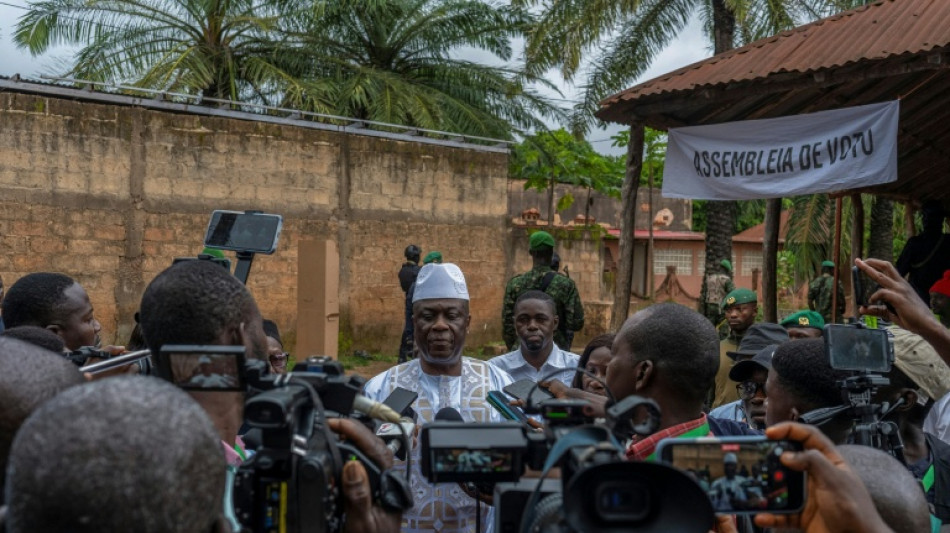
G.Bissau moves towards postponement of December general election / Photo: Samba BALDE - AFP

Guinea-Bissau's electoral commission announced Thursday that conditions had not been met to organise its December 6 presidential and legislative vote, which was meant to restore civilian rule after a coup last November.
The perennially unstable west African nation has been gripped by significant political and security turmoil for several weeks, as the December deadline approaches.
Junta leader General Horta N'Tam summoned the National Electoral Commission (CNE) for a meeting, its vice president Felisberta Moura Vaz told reporters.
She said the body had informed him that the "conditions necessary to organise elections by December 6 will not be met".
When asked by journalists about the possibility of delaying the vote, Vaz replied: "I will not say that the elections will be postponed. That is a matter for the transitional president", another title held by N'Tam.
The army in Guinea-Bissau seized power last November just days after a presidential vote, overthrowing president Umaro Sissoco Embalo and suspending the electoral process.
The junta established under N'Tam, a close associate of Embalo, had set December 6 as the date for presidential and legislative elections meant to restore civilian rule.
Embalo had told AFP that he would return from exile in Morocco and stand in the elections, but the junta last week said that "security conditions" were not met for Embalo's return.
N'Tam's prime minister, Ilidio Vieira Te, said he as well had met with N'Tam Thursday and that "the conditions for holding credible elections do not exist".
He said that "no political party is yet in an ideal position to contest the elections" and that "the leadership of most of these parties is outdated. This calls for a renewal of the grassroots organisations".
- Embalo, junta ties -
Many observers suspected Embalo of orchestrating the November 26 coup to halt an election process he appeared to be losing.
The coup occurred one day before provisional results were to be announced.
However, the junta has more recently taken several steps suggesting it is distancing itself from the former president.
Embalo's barring from return last week came amid reports of discontent within the presidential guard, a unit seen as loyal to the former president.
Several members of the guard were subsequently disarmed and placed under supervision at military headquarters.
And speaking at a ceremony in the capital Bissau on Wednesday, N'Tam called on guard members still holding weapons to hand them over as soon as possible.
In August Guinea-Bissau's leaders held a referendum in which voters ushered in a constitutional change that gives the president more powers.
The junta said the change would stabilise institutions before the elections, but the opposition urged citizens to boycott the process.
Guinea-Bissau, a Portuguese-speaking country wedged between Senegal and Guinea, has experienced five coups and numerous attempted putsches since independence from Portugal in 1974.
The nation's crippling poverty and political chaos have also made it a fertile ground for corruption and drug smuggling.
I.Saccomanno--PV