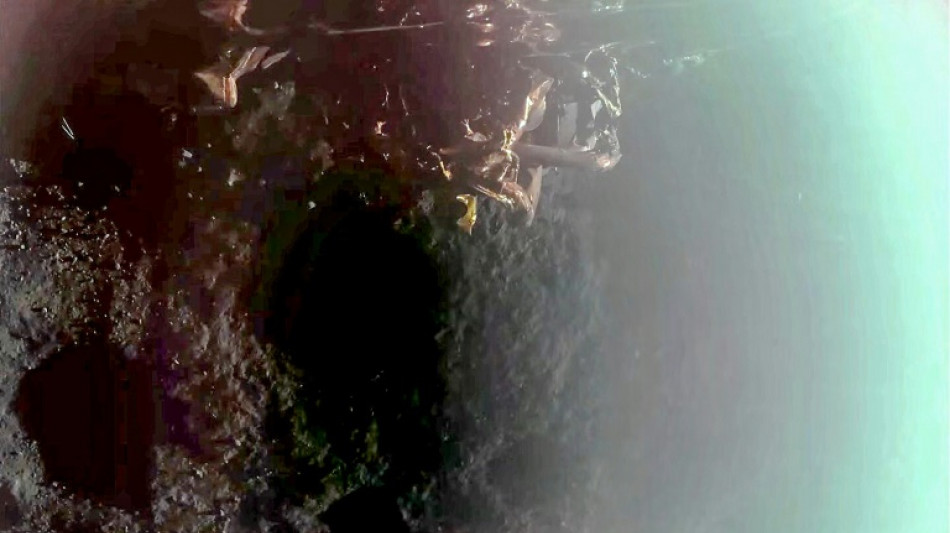
Private US company aces lunar landing on first mission / Photo: Handout - Firefly Aerospace/AFP

A US company successfully landed its spacecraft on the Moon on Sunday, marking only the second private mission to achieve the milestone -- and the first to do so upright.
Firefly Aerospace's Blue Ghost Mission 1 touched down at 3:34 am US Eastern Time (0834 GMT) near Mons Latreille, a volcanic formation in Mare Crisium on the Moon's northeastern near side.
The mission control team in Austin, Texas, erupted in cheers as CEO Jason Kim confirmed that the spacecraft was "stable and upright."
That stood in stark contrast to the first private lunar landing last February, which toppled over upon arrival, dulling the achievement of being the first US Moon touchdown since the crewed Apollo 17 mission of 1972.
"We're on the Moon!" exclaimed Nicky Fox, associate administrator for NASA's Science Mission Directorate.
Blue Ghost's program manager, Ray Allensworth, highlighted the precision of the landing, noting it touched down within 100 meters of its target.
"We did do two hazard avoidance maneuvers on the way down -- that tells us that our software did work exactly as it needed to," she told reporters.
The first image from the lander revealed rugged, pockmarked terrain that Blue Ghost had to autonomously navigate during its final descent, slowing from thousands of miles per hour to just two mph.
Meanwhile, 95-year-old Apollo 11 astronaut Buzz Aldrin joined the celebration from home, posting his congratulations on X along with a video of himself in pajamas, beaming and flashing a thumbs-up at the webcast.
- NASA experiments -
Nicknamed "Ghost Riders in the Sky," the mission is part of a $2.6 billion NASA partnership with industry called Commercial Lunar Payload Services, which aims to cut costs and support Artemis, the program designed to return astronauts to the Moon.
The golden lander -- about the size of a hippopotamus -- launched on January 15 aboard a SpaceX Falcon 9 rocket, capturing spectacular footage of Earth and the Moon over its 2.8 million-mile (4.5 million-kilometer) journey. It shared the ride with a Japanese company's lander aiming for its own touchdown in May.
Blue Ghost carries 10 instruments, including a lunar soil analyzer, a radiation-tolerant computer and an experiment testing the feasibility of using the existing global satellite navigation system to navigate the Moon.
Designed to operate for a full lunar day (14 Earth days), Blue Ghost is expected to capture high-definition imagery of a total eclipse on March 14, when Earth blocks the Sun from the Moon's horizon.
On March 16, it will record a lunar sunset, offering insights into how dust levitates above the surface under solar influence -- creating the mysterious lunar horizon glow first documented by Apollo astronaut Eugene Cernan.
- Another lander coming -
Blue Ghost will be followed on March 6 by fellow Texas-based Intuitive Machines' IM-2 mission, featuring its lander, Athena.
During the company's first mission in February 2024, the lander touched down too fast, snagging a foot on the surface and toppling over, cutting operations short.
Intuitive Machines says it has since made key improvements to the hexagonal-shaped vehicle, which has a taller, slimmer profile than Blue Ghost and is roughly the height of a giraffe.
Athena aims to touch down farther south on the Moon than any previous mission and its payloads include three rovers, a drill to search for ice, and the star of the show: a first-of-its-kind hopping drone.
Landing on the Moon is uniquely challenging due to its lack of atmosphere, making parachutes useless. Instead, spacecraft must rely on precisely controlled thruster burns to slow their descent while maneuvering over hazardous terrain.
Until Intuitive Machines' first mission, only five national space agencies had accomplished this feat: the Soviet Union, the United States, China, India and Japan, in that order.
The missions come at a delicate moment for NASA, amid speculation that it may scale back or even cancel its Artemis lunar program in favor of prioritizing Mars exploration -- a key goal of both President Donald Trump and his close advisor, SpaceX founder Elon Musk.
D.Vanacore--PV