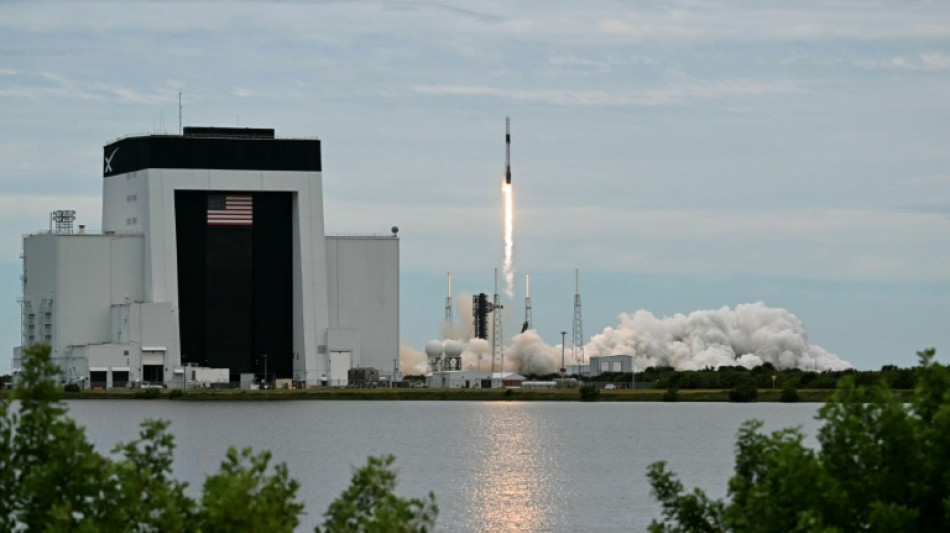
Four-member crew docks at International Space Station / Photo: CHANDAN KHANNA - AFP

Four new crew members for the International Space Station docked Thursday at the orbiting laboratory where they will stay for approximately six months.
The SpaceX Falcon 9 rocket carrying the Crew-13 mission team lifted off at 11:10 am local time (1510 GMT) from Cape Canaveral, Florida.
Seven hours and 55 minutes later, the SpaceX Dragon "Grace" capsule docked at an ISS port, setting a record for the fastest trip by a US spacecraft to the outpost, NASA officials said.
In a live broadcast on NASA TV, the capsule appeared to glide gently toward a stationary ISS as both hurtled through space at some 17,500 miles (28,163 km) per hour.
"Dragon SpaceX on the big loop. Hard capture is complete," a ground control official announced, signalling completion of docking.
Up next: the opening of hatches enabling the new arrivals -- Americans Jessica Watkins and Luke Delaney, Canadian Joshua Kutryk, and Russian Sergey Teteryatnikov -- to float into the space station through a pressurized vestibule.
The duration of the journey depends greatly on the distance between the ISS and the spacecraft at the time of launch.
It took more than 30 hours for the last crew that launched from American soil to reach the station.
The new ISS crew was initially meant to arrive in mid-September, but its launch was postponed due to a leak aboard the Dragon.
Crew-13 is taking over from Americans Jessica Meir and Jack Hathaway, Frenchwoman Sophie Adenot and Russian Andrey Fedyaev.
Crew-12 is set to return to Earth as early as Monday, though the schedule depends on weather conditions.
Canadian Kutryk will have an extra reason to look forward to his return in six months' time -- his wife is due to give birth during his stay in space.
Continuously inhabited for the last quarter-century, the aging ISS is scheduled to be pushed out of orbit before crashing into one of Earth's oceans sometime around 2030.
Despite many international cooperation agreements falling apart after Moscow invaded Ukraine in 2022, the United States and other ISS partners have continued working with Russia on the space station.
L.Barone--PV