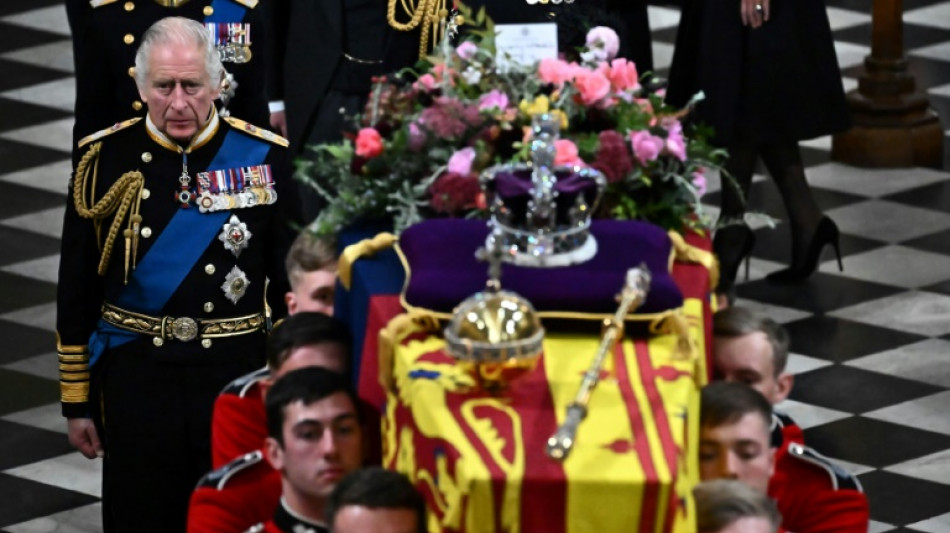
Wedding, coronation, now funeral: emotive farewell to queen / Photo: Ben Stansall - POOL/AFP

Queen Elizabeth II was married and crowned in Westminster Abbey. In death, she entered and departed the thousand-year-old church to the same words of prayer: "May God grant to the living, grace; to the departed, rest."
The words are engraved on a stone slab next to the Great West Door through which Elizabeth's coffin was borne for Monday's Anglican funeral service, attended by leaders of all faiths from around the world.
They were the same words intoned by the dean of the abbey, David Hoyle -- part of the final blessing concluding the hour-long service, before trumpeters sounded the Cavalry Last Post.
Then followed a two-minute silence in the abbey and throughout the new kingdom of the late monarch's eldest son, now Charles III.
The ceremony closed with the national anthem, "God Save the King", symbolising the transition from one reign to another, and a lone piper playing the Scottish lament "Sleep, dearie, sleep".
Eight minutes before arriving at the abbey, the coffin had departed on a gun carriage pulled by Royal Navy sailors from Westminster Hall, where hundreds of thousands of public mourners had filed past since Wednesday.
At one end of the medieval hall, it passed under a stained-glass window commissioned by parliament for the queen's record-breaking Platinum Jubilee this year, and then past a fountain erected in 1977 for her Silver Jubilee.
The window features the royal coat of arms with the monarch's motto "Dieu et mon droit" (God and my right) -- symbolising, like the funeral service, the monarch's divinely ordained role as guardian of the nation.
On the heavy lead-lined oak coffin lay a new wreath of flowers, with the message "In loving and devoted memory. Charles R" (for Rex, or king).
The coffin also bore the instruments of state -- the Imperial State Crown, the Orb and the Sceptre.
They were to be placed on the high altar of St George's Chapel in Windsor Castle, where the queen was to be buried after a final military procession from the abbey to London's Wellington Arch.
- 'We will meet again' -
The burial was to be a private affair for the royal family -- in contrast to the grandeur and public nature of the televised abbey service, a last opportunity for the nation and world to bid adieu.
Leading up to the service, Westminster Abbey's tenor bell tolled every minute for 96 minutes, signifying the age at which Britain's longest-reigning sovereign died on September 8.
Through the Great West Door, eight pallbearers from the Grenadier Guards bore the coffin past the Tomb of the Unknown Warrior, an eternal tribute to Britain's war dead.
They processed down the nave to the high altar, accompanied by a choir singing biblical verses starting with words from the New Testament book of John: "I am the resurrection and the life."
In his sermon, Archbishop of Canterbury Justin Welby noted words the queen used in a broadcast when Britain went into lockdown at the start of the Covid pandemic, plunging millions into anxious isolation.
She in turn had drawn on a famous World War II song by much-loved singer Vera Lynn: "We will meet again."
"Service in life, hope in death," Welby intoned. "All who follow the queen's example, and inspiration of trust and faith in God, can with her say: 'We WILL meet again.'"
The service included New Testament readings by Commonwealth secretary-general Patricia Scotland and by Liz Truss -- who was appointed by the queen as her 15th prime minister only two days before she passed away.
As the coffin was borne out, the abbey organist played a sonata allegro movement by Edward Elgar -- part of a musical programme drawing heavily on English composers that was selected by the queen herself, along with the hymns and prayers.
When applause swept through the abbey from the crowds outside during the funeral of Diana, princess of Wales in 1997, it seemed revolutionary and a threat to the monarchy.
Z.Ottaviano--PV