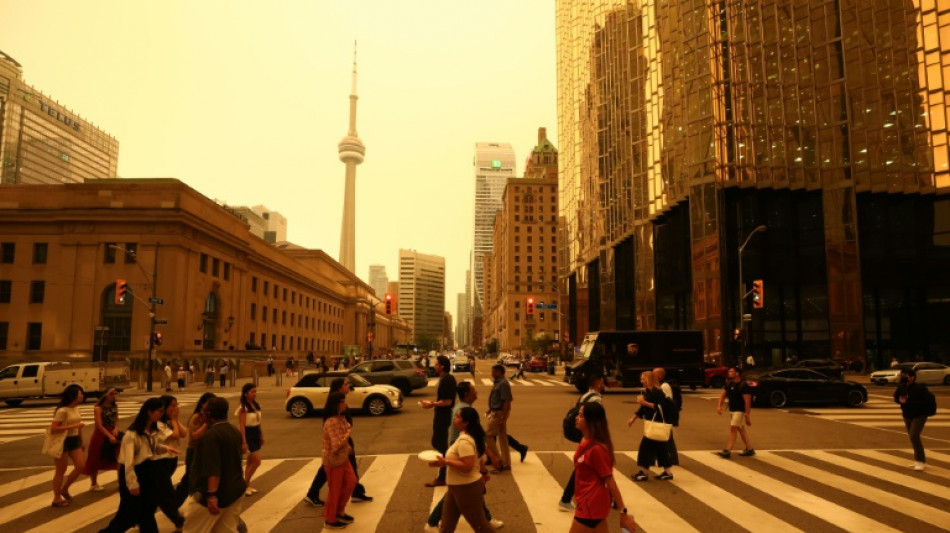
Hazardous wildfire smoke chokes millions in US, Canada / Photo: Cole BURSTON - AFP

Out-of-control wildfires were raging Thursday in the Canadian province of Ontario, prompting evacuations and sending dangerous smoke billowing into the United States where millions of people were exposed to the unhealthy air.
US states near the Canadian border including Minnesota, Wisconsin, Michigan and Illinois were particularly choked, as forecasters predicted the Northeast including New York would also see air quality continue to deteriorate.
On Thursday morning, tracker IQAir listed Detroit, Toronto, Minneapolis and Chicago as the most polluted cities in the world.
A hazy cast hung over New York where forecasters expected the densest strip of smoke to cloud the region into the afternoon.
A New York state air quality health advisory warned of fine particulate matter from the fires that would make the outdoors "unhealthy" for everyone across the New York metro area and Long Island, with even worse conditions in the central and western regions of the state.
Authorities encouraged New Yorkers to spend as little time outside as possible.
Mayor Zohran Mamdani warned that "the combination of dangerous heat and unhealthy air is a serious threat."
Libraries and train stations were offering free masks, while hundreds of cooling centers were open across the city for those without access to air conditioning.
"This could become the most significant smoke event in New York City since 2023, and conditions will be closely monitored for any deterioration," the city's Department of Emergency Management said.
That year, the city's skies turned an apocalyptic orange, and the air quality index reached a hazardous 465.
- Lingering smoke -
In the Midwest, levels had already surpassed that, with Detroit hovering around 700, according to the US Environmental Protection Agency tracker, after it had pushed even higher overnight.
The Michigan Department of Environment, Great Lakes, and Energy said it expected hazardous conditions to continue through Friday, and that "our best model for smoke only predicts out to 48 hours."
"That model is currently showing improvements on Saturday, but it is likely that smoke will linger and recirculate for a while," the agency said.
In Canada, the latest data shows there are more than 130 active fires in northwestern Ontario, with at least 60 out of control.
Authorities there have formally requested additional assistance from the federal government, in particular seeking air support to evacuate remote communities.
"More than 150 fire crews and nearly 50 firefighting aircraft are working around the clock to protect communities from the fires in northern Ontario," said the province's Premier Doug Ford on X.
So far, Canadian wildfires have scorched 1.9 million hectares (4.7 million acres) this year, an area nearly the size of Slovenia.
That damage remains far off the pace of 2023, Canada's worst wildfire season on record, when nearly 18 million hectares burned in the country.
A.dCosmo--PV