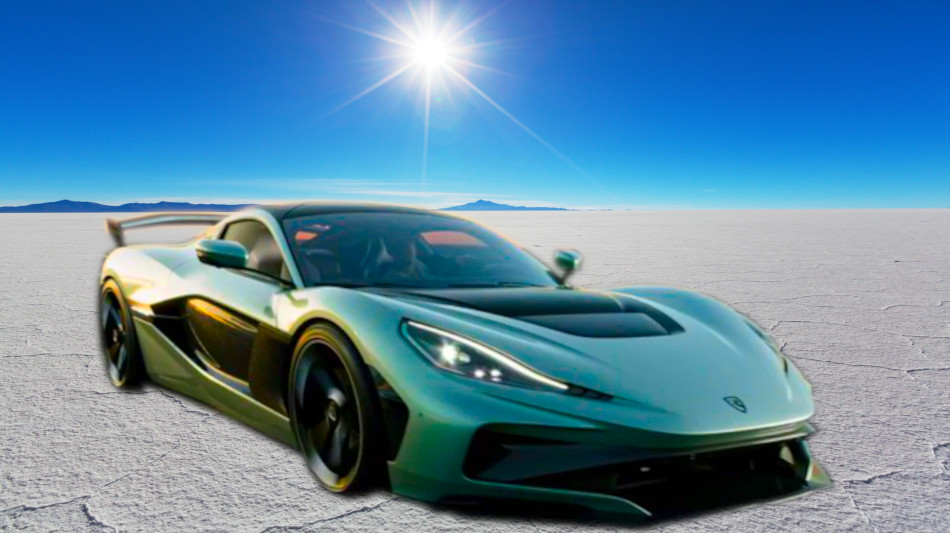
Rimac Nevera R: Beyond imagination

There are vehicles that define a class. And there are vehicles that define a benchmark for which there was not even a reasonable scale before. The Rimac Nevera R is just such a case: a fully electric hypercar that is not only faster than most of what we know, but whose technical logic stems more from the world of high-performance test benches, aerodynamics laboratories and control software than from classic sports car romanticism.
Yet the Nevera R is not intended to be ‘just another special edition’. Rimac describes it as a counterpoint to the grand tourer concept of the original Nevera: less ‘hyper GT’, more ‘hyper sports car’. The letter R symbolises a philosophy that is rarely seen implemented so consistently in everyday life: radical, rebellious, relentlessly refined. The goal is clear – not only to achieve top speeds in a straight line, but above all to deliver a new level of quality in corners, when braking and in the feedback to the driver.
Performance that no longer sounds like an ‘engine’, but like a system
The Nevera R relies on four electric motors – one for each wheel. This layout is not new in the Rimac universe, but in the R version it is taken to the next level. The focus is not only on maximum power, but also on how precisely it is distributed. With around 1,571 kW (2,107 hp), the Nevera R operates in a performance sphere where classic comparisons quickly seem ridiculous: not because combustion engines are ‘too weak’, but because the electrical system consisting of motors, inverters, battery and software scales completely differently.
On paper, this is impressive. In practice, it only becomes truly tangible when you understand the consequences: four drives don't just mean all-wheel drive – they mean that traction and torque can be shaped individually for each wheel in milliseconds. ‘A lot of power’ becomes ‘power in the right place at the right time’.
Aerodynamics: downforce without drama, efficiency with a statement
Anyone who dismisses the Nevera R as just a ‘Nevera with wings’ is overlooking the core of the redesign. The R variant features a large, fixed rear wing and a significantly more aggressive aerodynamic design, including a large diffuser. The point is not show, but physics: more downforce means greater stability at speed – and, above all, more potential in fast corners and when braking.
Rimac quantifies the gain very specifically: 15 per cent more downforce and, at the same time, 10 per cent better aerodynamic efficiency. This is a combination that is challenging to develop because more downforce often means more drag. This is precisely where it becomes clear how much the Nevera R is designed as a complete system: The aerodynamics should not only ‘stick’, but also remain controllable – at high speeds as well as on winding roads.
Tyres, geometry, wheels: the focus on corners is not just marketing
A hypercar can only be as good as its contact with the road. That's why the Nevera R relies on Michelin Cup 2 tyres, which are clearly designed for performance. But tyres alone do not make a vehicle a cornering artist. The decisive factor is the interaction between rubber compound, temperature window, chassis geometry and control.
Rimac also cites measurable effects here: 10 per cent less understeer, 5 per cent more lateral acceleration grip – and as a result, a 3.8-second faster lap time on a handling course in Nardò. The hardware side fits in with this: the Nevera R comes with 21-inch wheels at the rear and 20-inch wheels at the front – a combination that supports traction and steering precision and further emphasises the vehicle's visually ‘forward-leaning’ stance.
Battery and thermal management: 108 kWh as a performance tool, not a range statement
The Nevera R features a next-generation 108 kWh battery pack. What is remarkable is not so much the pure capacity as the design: Rimac talks about a lighter pack that is supposed to enable more power and efficiency at the same time.
For a hypercar that aims for repeatable performance, this is the crucial point. Because extreme acceleration is only half the story – the other half is how stable the temperature management, power output and control remain when the vehicle is challenged not just once, but repeatedly.
Batteries and power electronics are mercilessly exposed on the racetrack in particular: when the thermals tip, performance tips. That's precisely why the Nevera R relies on a performance-oriented system design – with the aim of making the full characteristics available not just ‘for one run’, but in repeated use.
Brakes: When acceleration is absurd, deceleration must seem superhuman
In this performance class, braking performance is not a minor matter, but a core competence. The Nevera R uses EVO2 brakes as a carbon-ceramic system with a silicone matrix layer, designed for higher stability, better cooling and continuous load. That sounds like engineering jargon – and that's exactly what it is: a 2,000 hp class is only drivable if deceleration, pedal feel and temperature management are on par.
The special point is that in the Nevera R, brakes are not just a ‘component’ but part of an overall promise. A car that shoots to extreme speeds in fractions of a second must also be able to come to a stable, precise and controlled stop in fractions of a second – without the driver feeling like they are fighting physics.
Software as the real star: next-generation torque vectoring
If you had to name one game changer in the Nevera R, it would be the software – more specifically, the next-generation all-wheel torque vectoring (R-AWTV) and the assistance and driving dynamics functions tailored to it. After all, four motors are only an advantage if they work together like an orchestra rather than against each other.
Rimac has not only retuned the torque vectoring, but also revised the traction control, drift mode and steering tuning. The aim: sharper steering, clearer feedback, greater predictability – even when conditions deteriorate. At a time when many supercars define themselves by ‘more power,’ the Nevera R seems almost like a counterstatement: it's not just how much power is available that matters, but how intelligently it is used.
Records that are not meant to be a show – but as proof
Rimac ranks the Nevera R among a series of verified performance records. For 2025, there is talk of 24 confirmed records – including figures that read more like laboratory parameters: 0–60 mph in 1.66 seconds, 300 km/h in 8.66 seconds and a documented top speed of 431.45 km/h. At the same time, practical experience shows that such top speeds can usually only be achieved under defined conditions and with approval – because in this region, speed is no longer a matter of ‘driving performance’ but of risk management.
What is interesting here is not so much the record itself as the statement behind it: the Nevera R is not optimised for a single discipline, but rather for a package that combines acceleration, stability, braking, grip and control. This is precisely what creates this new, difficult-to-classify dimension: a road vehicle that resembles a prototype in terms of measurements and system logic – and yet is intended as a production vehicle.
Exclusivity with real consequences: 40 vehicles – and a ‘Founder's Edition’
The Nevera R is limited to 40 units worldwide. In this context, ‘limited’ does not seem like a selling point, but rather a technical necessity: handcrafted construction, use of materials, development effort and customisation are part of the product in this league.
In addition, there is a Founder's Edition limited to ten vehicles, which was unveiled to the public in early 2026 – including the first delivery at a winter event in St. Moritz. This edition is not aimed at more performance, but at maximum personalisation and a special ownership experience: from intensive configuration at the Rimac Campus in Zagreb to driver training by the test team. The message is clear: the Nevera R is not just a car, but a programme – a high-performance project with road approval.
The moment when ‘beyond normal expectations’ becomes literal: Rimac technology in aviation
Just how far this self-image extends is demonstrated by an event in February 2026 that, at first glance, has little to do with cars: aerobatic pilot Dario Costa landed an aeroplane on a moving freight train and then took off again – a manoeuvre that, according to those involved, had never been performed in this form before. The key data seem like a test question from an engineering degree: 120 km/h train speed, 2.5 kilometre distance, 87 km/h approach close to stall, strong air turbulence, a 50-second time gap for touchdown, braking, acceleration and take-off.
And right in the middle of it all: the Rimac Nevera and Nevera R as training tools. A test programme lasting several days was carried out at an airport in Croatia, with the hypercars serving as high-precision, mobile reference platforms – to train speed synchronisation, distance estimation and timing under real conditions. This is where the Nevera R concept takes on a second dimension: when a car serves as a ‘mobile reference point’ for an aviation manoeuvre, it's not just a PR anecdote, but an indication of how precise and reproducible such systems can be.
Even more exciting: Rimac engineers also supported the project beyond the vehicles – with a custom-made seat for the pilot, manufactured with expertise in composite materials and ergonomics, and with flow simulations for aerodynamic optimisation of the cockpit canopy. At this point, at the latest, the line between automotive and aerospace development becomes blurred. The Nevera R thus represents not only a new hypercar, but also technical expertise that can be applied in related high-performance fields.
Conclusion: The Nevera R is not a ‘fast car’ – it is a mobile development statement
The Rimac Nevera R 2026 is the kind of vehicle that cannot be meaningfully explained in terms of ‘horsepower’ or ‘0–100’ – even though these figures are breathtaking. Its real core lies in the system concept: four motors, a high-performance battery, aerodynamics, tyres, brakes and control as a closely interlinked unit. Added to this is an unusually consistent claim: not only to set records, but to master driving dynamics in such a way that they remain reproducible, usable and controllable.
This creates a new dimension beyond normal expectations: a hypercar that doesn't pretend to be a racing car – but one that translates racing car logic into a series production vehicle. And in doing so, it shows that high performance today smells less of petrol and more of software, flow patterns, materials technology and precise control.