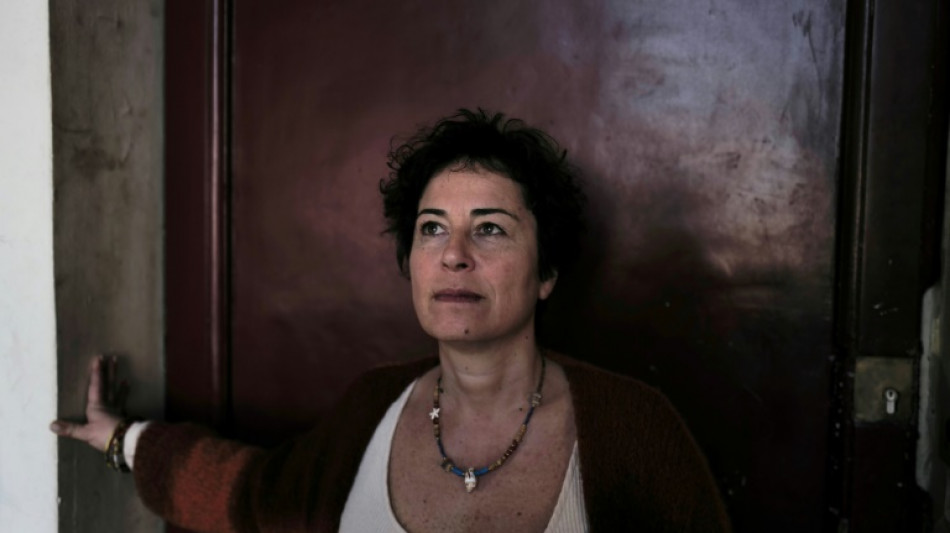
Dissident Selek says won't return to Turkey to stand trial / Photo: Valery HACHE - AFP

Pinar Selek, a Turkish-French dissident sociologist living in France, will not go to Turkey to face trial, the latest twist in 25-year legal battle with the authorities, she told AFP.
Turkey has accused Selek over a 1998 explosion that killed seven people and, even after four acquittals, wants her in the dock again after issuing an international arrest warrant in January.
In an interview with AFP in the southern French city of Nice where she teaches sociology, Selek said: "You never get used to injustice".
Although the successive trials, acquittals and retrials started well before President Recep Tayyip Erdogan came to power, she said they "are an illustration of both the continuity of the repressive regime, and the new tools of the regime".
Selek, now 51 and known for her critical studies of the Kurdish conflict in Turkey and her work with street children, was first arrested in 1998 and accused of belonging to the PKK, a Kurdish militant organisation considered by Turkey and its western allies -- including the United States and the European Union -- to be a terrorist organisation.
She was then accused of bombing a spice market popular among tourists in Istanbul, a charge she was informed of only "when I was already in my prison cell".
But then a witness, who had testified that she had been part of the plot, withdrew his statement. An expert report concluded that the explosion had been an accident. Selek was freed in 2000 with the court citing lack of evidence, but the trial was not over.
She moved to France and pursued her sociology research, first in the eastern city of Strasbourg and then in Nice in the south, and obtained the French nationality in 2017.
- 'Safe in France' -
But back home, the judicial process against her ground on. She was acquitted in 2006, then again in 2008 and again in 2011. But each time, the supreme court cancelled the acquittals.
In 2012 a court in Istanbul decided on a retrial and, a year later, sentenced her to life imprisonment.
The supreme court overturned that verdict, too, and ordered another retrial which ended with yet another acquittal, in 2014.
Then, in June of last year, the supreme court intervened again, annulling all previous acquittals.
An international arrest warrant was issued, and a new court date set for March 31.
"I'm not going to my trial, I can't go to Turkey," she said in the interview. "I feel safe in France, my lawyers have advised me not to leave the territory."
But, she said, there would be "around a hundred people" to represent her. "Parliamentarians, academic colleagues and activists from several countries. There is an incredible mobilisation," she said.
Selek said she hoped to win her own fight against the judiciary, and also wished for Turkey to "enter a process of justice for everybody", including prisoners.
"That country has become a huge prison. People who were untouchable before are now behind bars, great filmmakers, writers, activists, Kurds and many women. I try to do what I can to be their voice," she said.
Her defence in the upcoming trial will be handled by her father, a 93-year-old lawyer, and her sister, a lawyer and former economist.
"She's a feminist, and very active in the social movements for democracy and freedom," Selek said of her sister. "Like my father, she doesn't want to leave Turkey because they want to change things from within."
Would she herself return home if Turkey had a different president? "I don't think the question of my return depends entirely on Erdogan," she replied.
She said her ordeal started because of the Grey Wolves, an ultra-nationalist organisation, which she said preceded Erdogan and is still influential in government.
T.Galgano--PV