Pallade Veneta - Lucid Gravity 2026: Test report

Lucid Gravity 2026: Test report


Lucid Gravity 2026: Test report

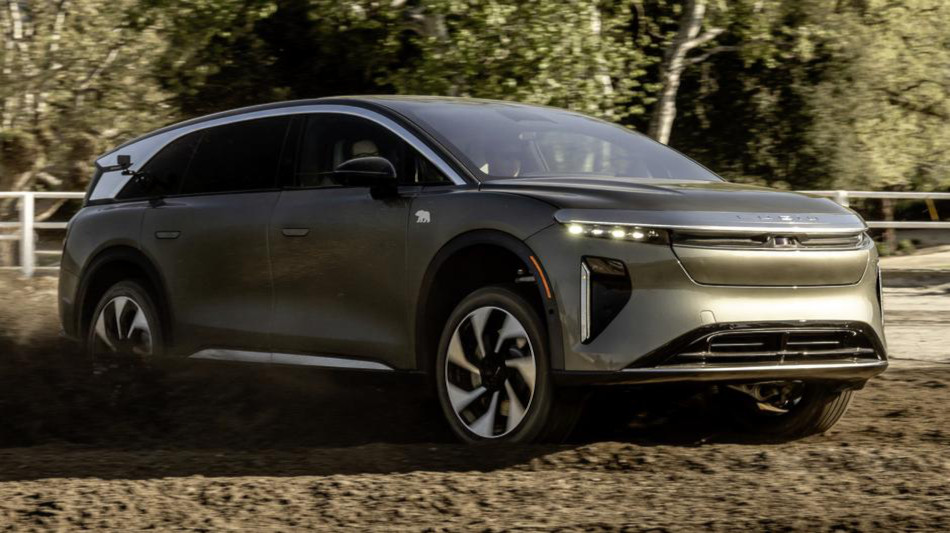
The new electric SUV from a US manufacturer combines the range of a saloon car with the elite space of a van. An extensive winter test covering 8,000 kilometres in Europe, in which pre-production vehicles travelled from the Munich development centre to the Arctic Circle, confirms this high and fulfilled claim. The development team examined both performance on unlimited motorway sections and charging at three-phase European AC connections and state-of-the-art fast charging stations. In extreme cold and summer heat, the interaction of drive, charging performance and comfort was tested to meet the expectations of European customers.

Design and space
With a length of around 5.03 metres, a wheelbase of over 3.3 metres and a drag coefficient of 0.24, the SUV is surprisingly aerodynamic despite its imposing dimensions. The flat silhouette and flush-mounted door handles emphasise its elegant appearance. The raised windscreen extends seamlessly over the passengers' heads and, together with the panoramic glass roof, creates an airy feeling of space. Depending on the configuration, the vehicle can seat five to seven adults. The second row of seats can be folded electrically into the floor; individual seats will also be available in future. An additional storage compartment under the front bonnet – known as the frunk – has a capacity of 227 litres and can be converted into a bench seat thanks to upholstery. When the rear seats are folded down, the load volume increases to up to 3,450 litres.

Change text size:

Drive, battery and performance
The SUV uses a modular electric architecture with all-wheel drive and two electric motors. In the basic Touring version, the system delivers 418 kW (568 hp) and accelerates to 100 km/h in 4.2 seconds. The range of the Touring variant is up to 545 kilometres according to WLTP. The more powerful Grand Touring version delivers 617 kW (839 hp), sprints from 0 to 100 km/h in 3.6 seconds and achieves a range of up to 748 kilometres. An extreme torque of 1,232 Newton metres is available right from the start, which corresponds to the acceleration of a sports car. With a top speed of 270 km/h, the SUV sets new standards for electric family vehicles.

At the heart of the drive system is a 123 kWh battery with 926 volt technology. This voltage enables charging capacities of up to 400 kW. Depending on the charging station, a range of 400 kilometres can be recharged in around a quarter of an hour. At 500-volt charging points, 225 kW is permanently available. The vehicle supports bidirectional charging, meaning it can also feed energy back into the grid or to external devices. The European test fleet also used the large number of three-phase AC connections to optimise the everyday usability of the charging system.

Driving performance and comfort
Despite its heavy weight of just under three tonnes, the SUV is surprisingly agile. Adaptive air suspension and optional rear-axle steering ensure high driving stability on long motorway journeys and precise handling on country roads. Three driving modes (‘Smooth’, “Swift” and ‘Sprint’) allow you to switch between a comfortable glider and a performance SUV. The acceleration pushes passengers noticeably into their seats, but the suspension confidently irons out any bumps. The manufacturer even considers the model to be off-road capable; thanks to the air suspension, the ground clearance can be increased to such an extent that it rivals that of an iconic off-road vehicle. In practice, however, the SUV will mainly be used on paved roads.

Interior, infotainment and equipment
The cockpit is dominated by a 24-inch 6k OLED display that floats above the dashboard as a continuous panel. Below it is a second Full HD display for important functions. Both screens can interact and, during charging, show an animated surf reminiscent of the sound of the sea. Operation is almost exclusively via touch surfaces; even the mirror and glove compartment controls have been digitised. Haptic touch controls on the square steering wheel support menu navigation, while voice control with the command ‘Hey Lucid’ offers additional operating options.

Standard equipment includes four-zone climate control, ambient lighting, massage and ventilated front seats, and a Dolby Atmos sound system with 22 speakers. There are five different colour and material themes to choose from, with a special focus on sustainable materials. Large storage compartments in the doors, a sliding centre tunnel and a deep glove compartment offer plenty of storage space. To sum up the equipment without exaggeration: luxury as far as the eye can see!

Safety and assistance systems
The manufacturer has equipped the SUV with modern driver assistance systems. An invisible ‘co-pilot’ assists with driving and parking, while a system called ‘HaloSecure’ monitors the surroundings and detects potential hazards. In addition, there are functions required by EU regulations, such as emergency braking and lane departure warning systems, intelligent speed assistance, reversing assistance, fatigue warning and tyre pressure monitoring. Official crash test results are not yet available, but a similar saloon from the manufacturer has already received the highest rating in safety tests.

Warranty and reliability
Customers receive a four-year or 80,000-kilometre vehicle warranty, the powertrain is covered for up to 160,000 kilometres and the high-voltage system for ten years. However, there is a lack of long-term experience because the manufacturer has only a few models on the market. There have been isolated recalls and software problems with the saloon; whether the new SUV will experience similar teething problems will only become apparent after the first deliveries.

Market launch and prices
Production of the Grand Touring variant began in Arizona in the United States at the end of 2024, with the Touring version following a year later. In Europe, the SUV has been available to order since autumn 2025; the first deliveries for Germany were also made in autumn 2025, and production is ongoing. Prices start at around £99,900 for the Touring variant, while the Grand Touring version is available from £116,900.
 
In the USA, the base model starts at around $79,900, while the higher-powered version costs from $94,900. A future entry-level model could further round off the price range below €100,000.

Conclusion on the new Gravity
The new electric SUV sets new standards with its powerful drive, record-breaking charging capacity and generous space. Winter testing in Europe shows that the vehicle performs extremely reliably even under extreme conditions and is adapted to the requirements of European roads and charging infrastructure. The combination of pure luxury, practical versatility and impressive performance makes the model a serious competitor for established premium manufacturers. However, high prices and a still sparse distribution network could severely limit its success, but its technical capabilities promise an exciting future for the electric SUV.

Featured

Alfa Tonale 2026: With a new look

Alfa Romeo has given its Tonale compact SUV, launched in 2022, a very subtle but effective update. Three years after its debut, the designers are drawing on Alfa's typical heritage and sharpening its profile: The front now features a more pronounced, concave Scudetto radiator grille, which references the historic ‘33 Stradale’ with horizontal struts. The grille is flanked by a redesigned front apron, in which a wider air intake and side openings give the Tonale a more dynamic look. Alfa Romeo has also shortened the front overhang and widened the track, giving the car a more muscular appearance. Newly designed alloy wheels in sizes ranging from 17 to 20 inches and fresh paint finishes – including Rosso Brera, Verde Monza and Giallo Ocra – underline the refreshed look.Interior: new colours, more comfortThe interior also benefits from ‘a little cosmetic surgery’. Alfa Romeo is expanding its range with new colours and materials. In addition to the familiar black fabric and leather upholstery, bright red leather seats or a two-tone combination of white imitation leather and black Alcantara are available for the first time. A new ‘Cannelloni’ seat design with pronounced cross-beading is reminiscent of the sports seats from the 1960s. Perforated Alcantara upholstery with white or ‘Ice’ contrast stitching is available for the Sport Speciale variant; the dashboard is also trimmed in Alcantara. LED ambient lighting in various colours, including a serpentine pattern paying homage to the coat of arms of Milan, further enhances the cockpit. In Europe, a flat rotary knob replaces the previous gear lever, while the US version retains a classic gear selector – both variants feature large aluminium paddle shifters on the steering wheel. The infotainment system includes a 10.3-inch touchscreen and a 12.3-inch digital speedometer; a 360-degree camera, wireless charging and a Harman Kardon sound system are available as options.

BMW 7 Series and i7: facelift in 2026

The seventh generation of the BMW 7 Series will be presented in a comprehensively revised form from 2026. We have created a graphic preview in the form of a photo, but whether this corresponds to reality is still questionable, to say the least. Around four years after the series made its debut, the Munich-based manufacturer's flagship model will undergo a so-called life cycle impulse, which offers much more than just cosmetic changes. The first prototypes, which were spotted on test drives around the Nürburgring, reveal that BMW is becoming bolder in its design: the striking double kidney grille remains divided into two parts, but appears lower and less bulky thanks to horizontal bars. In addition, the narrow daytime running lights have been redesigned into more delicate daytime running light clips. The rear end will feature a clearer, horizontal light signature based on the design of the 5 Series. Four trapezoidal tailpipes reveal that powerful combustion engines will continue to be used, while an extended body variant is unnecessary as the current G70 model already comes with a long wheelbase as standard.In the interior, BMW is focusing on a technological revolution. The new Panoramic iDrive – a further development of the classic head-up display – projects driving-related information across the entire width of the windscreen, largely replacing the conventional instrument cluster. The driver operates the system via a central touch display with Quick Select logic and a new multifunction unit on the steering wheel, whose buttons provide haptic feedback. Together with the optional 3D projection in the driver's field of vision, the system enables intuitive, distraction-free operation. Another highlight is the integration of innovations from the ‘New Class’, which BMW will gradually roll out in all model series from 2025 onwards. These include more connected on-board electronics and more powerful computers, which are a prerequisite for new Level 3 assistance systems. Additional sensors in the front apron indicate the use of the Personal Pilot system, which is designed to enable temporary autonomous driving in defined situations.

Bentley: Visions for 2026

Bentley returns to its roots in 2026 with the Continental GT Supersports, one of the most extreme versions of the two-seater grand tourer ever to hit the road. A hundred years after the first ‘Super Sports’, the new Supersports remains true to its name: it will be limited to just 500 numbered units and offers the purest driving experience.At the heart of the Supersports is the revised 4.0-litre twin-turbo V8 with enlarged turbochargers and reinforced cylinder heads. With 666 PS and 800 Nm of torque, it achieves the highest performance ever achieved in a Bentley V8. Power is transmitted to the rear wheels via an eight-speed dual-clutch transmission – a departure from the usual all-wheel drive and an expression of the purist concept.The Supersports' performance is impressive: 0–100 km/h in 3.7 seconds and a top speed of around 310 km/h. To ensure the car remains stable at high speeds, the aerodynamics have been comprehensively optimised. A huge front splitter, side skirts, aprons and a fixed rear wing generate over 300 kilograms of additional downforce compared to the Continental GT Speed. The weight reduction extends from carbon fibre body parts to a complete titanium exhaust system; the total weight remains below two tonnes, enabling the car to achieve 1.3 g of lateral acceleration.In the interior, Bentley has opted for a combination of carbon fibre and fine leather. The traditional rear seats have been replaced by two lower-positioned sports seats to save weight and lower the centre of gravity. As usual, customisation is possible through the in-house refiner Mulliner, with new colour and material combinations available. Orders for the Supersports will start in March 2026, with production starting later in the year. Bentley has not yet announced official prices, but experts expect them to be well into six figures.Urban SUV – first all-electric production modelWhile the Supersports celebrates the petrol tradition, Bentley is simultaneously venturing into the fully electric future. The British manufacturer has announced its first all-electric SUV, currently known under the working title ‘Urban SUV’, for the end of 2026. With a length of less than five metres, it is set to be more compact than the Bentayga and create a new market segment. The manufacturer promises tailor-made luxury and a wide range of personalisation options, as well as state-of-the-art technology.Technical details are still scarce, but Bentley confirmed at a press conference that the Urban SUV will be based on an 800-volt platform and will offer a charging capacity for a range of 160 kilometres in under seven minutes. The developers are thus aiming for industry-leading charging times. The platform is likely to come from the Volkswagen Group, as is already the case with other models in the Premium Performance Electric (PPE) modular system.Production of the pre-series vehicles has already begun in autumn 2025, and Bentley emphasises that the Urban SUV will be designed, developed and built entirely in Crewe. The market launch is planned for the end of 2026, with the first deliveries to customers scheduled for 2027. Inside, customers can expect a new level of digital connectivity, paired with sustainable materials and the typical Bentley finish. The trade press estimates the starting price at around €140,000, which would be below the Bentayga.

2026 S-Class starry facelift

When Mercedes‑Benz unveiled the 2026 S‑Class, it was clear that this was no ordinary facelift. Engineers replaced or refined more than 2,700 components, meaning over half of the vehicle is new. The changes begin on the outside: a 20 percent larger grille filled with hot‑stamped chrome stars projects a grander presence, while the traditional hood ornament now illuminates as part of the car’s striking light signature. Mercedes’ trademark three‑pointed star motif also appears in the headlights and taillights, underscoring the brand identity with refined opulence. Optional 20‑inch cross‑spoke wheels use high‑pressure casting to reduce weight and material consumption, and customers can choose from more than 150 paint colours.Digital light and starry illuminationLighting technology takes centre stage on the facelifted S‑Class. New micro‑LED Digital Light headlamps cut energy consumption in half while offering ultra‑range high beams that illuminate up to 600 metres ahead. The headlamps and taillamps embed miniature three‑pointed stars in their lenses, and the lights can project patterns such as welcome animations or warnings for oncoming drivers. These lamps are paired with a 20 percent larger grille outlined by a luminous frame and an illuminated bonnet star. At the rear, triple‑pod taillights with a star pattern and chrome accents contribute to a wider stance.An interior defined by screens and AIInside, the S‑Class adopts the MBUX Superscreen architecture. A 14.4‑inch central display is flanked by twin 12.3‑inch screens—one for the driver and another for the front passenger—forming a sweeping glass surface. Rear passengers enjoy two 13.1‑inch high‑definition displays with built‑in cameras. Mercedes’ latest software platform, MB.OS, underpins the cabin: it unifies navigation, vehicle systems and voice assistants. Generative AI powers the “Hey Mercedes” virtual assistant, enabling complex dialogue through voice assistants based on ChatGPT‑4o and Google Gemini. Navigation relies on Google Maps‑based data to provide real‑time traffic and 3‑D surroundings. Even the air vents are electronically controlled through Digital Vent Control, and an updated Energizing Air Control system filters cabin air for maximum purity.Comfort innovationsAlthough the cabin brims with screens, Mercedes preserved its luxurious ambience. Heated seatbelts can warm occupants to 44 °C (111 °F), while detachable remote controls allow rear passengers to adjust seat functions, climate and entertainment. The expanded Manufaktur programme offers nearly 50 bespoke paint finishes and 25 leather options, emphasising individuality. The interior retains high‑quality materials and adds Digital Vent Control for precise airflow. Mercedes has also equipped up to 10 external cameras, five radar sensors and twelve ultrasonic sensors, enabling advanced driver assistance and environment awareness.Handling and suspensionThe 2026 S‑Class comes standard with rear‑wheel steering that turns the rear wheels up to 4.5 degrees, reducing the turning circle by nearly two metres. Buyers can upgrade to an optional 10‑degree system for even tighter manoeuvrability. E‑Active Body Control, an active suspension that reads the road ahead, uses cloud‑sourced Car‑to‑X data to adjust damping at each wheel and can lift the car within milliseconds to mitigate side‑impact forces. This predictive suspension works alongside AIRMATIC air springs and electronically controlled dampers, delivering a blend of comfort and agility.

Change text size: